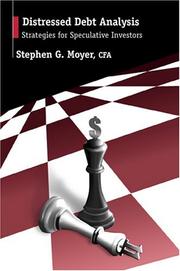
Distressed Debt Analysis
The practitioner manual on valuing claims through a restructuring.
Summary
Moyer wrote the standard practitioner text on analysing and investing in the securities of financially troubled companies. It combines the legal framework, the valuation methods and the investment strategies in one volume.
The legal sections cover the United States Chapter 11 process in detail: the automatic stay, debtor in possession financing and its priority, the absolute priority rule, classification of claims, the plan of reorganisation and the voting requirements, cramdown, adequate protection, avoidance actions and fraudulent conveyance, substantive consolidation, and the role of the creditors' committee. Moyer explains how these rules determine which claims receive what, and therefore where value flows.
The analytical sections cover enterprise valuation in distress, the difficulty of applying comparable company multiples to a company whose situation is not comparable, liquidation analysis, and the identification of what practitioners call the fulcrum security, meaning the class of claims that will be converted into the equity of the reorganised company and therefore captures the residual value. Identifying the fulcrum correctly is the central skill the book teaches.
The strategy sections cover trading claims, the different postures available including passive investment, active participation on committees and loan-to-own strategies aimed at control, and the specific risks including the loss of trading ability once a participant receives material non-public information.
The book is technical and assumes a working knowledge of corporate finance and accounting. It is oriented entirely to United States law, so it does not transfer to jurisdictions with different insolvency regimes. Practice has changed since the 2004 first edition and the 2012 second edition, particularly around liability management transactions, priming and non-pro-rata uptier exchanges, which have altered creditor expectations substantially in the years since.
Key takeaways 7
- The fulcrum security is the claim class that converts into the reorganised company's equity, and identifying it is the central analytical task.
- Absolute priority determines the order of recovery, but negotiated deviations from it are routine rather than exceptional.
- Debtor in possession financing takes priority over existing claims, so it changes the recovery arithmetic for everyone below it.
- Enterprise value in a distressed situation cannot be estimated from comparable multiples, because the comparables are not in the same condition.
- Liquidation analysis sets the floor on recovery and is what creditors can insist on if a plan is not confirmed.
- Receiving material non-public information through committee participation removes the ability to trade the claim.
- Chapter 11 outcomes are determined by negotiation among classes within a legal framework, so understanding the rules is a precondition for valuing anything.
Who should read it
Investors and advisers working in distressed credit who need the United States legal framework and valuation methods in one reference.
Where it sits in the reference 3
Similar books 6
Chosen by shared topics, the entries that hold them, and the people who recommended both.