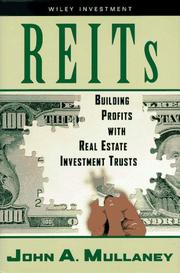
Real Estate Investment Trusts
Academic survey of REIT structure and performance.
Summary
Su Han Chan, John Erickson and Ko Wang wrote this as a survey of the academic research on real estate investment trusts, aimed at readers who want to know what the empirical literature establishes rather than what practitioners claim.
The questions they cover are the ones the research has addressed: whether REIT returns behave like equities or like direct property, and the finding that they correlate more with small-cap equities in the short run and with property over longer horizons; whether REITs provide diversification benefit in a mixed-asset portfolio; how REIT management structures, particularly the shift from external advisers to internal management after 1986, affected performance and conflicts of interest; whether REITs are efficiently priced, including the persistent discounts and premiums to net asset value; the effect of leverage; the determinants of REIT dividend policy given the distribution requirement; and the performance of REIT initial public offerings.
The book is a literature survey and reports findings with their qualifications rather than reaching confident conclusions. It was published in 2002, before the substantial growth of the sector, before REITs entered the major equity indices, and before the 2008 crisis tested their leverage and refinancing. The methodological framing remains useful for anyone evaluating current claims about the asset class.
Key takeaways 7
- REIT returns correlate with small-capitalisation equities over short horizons and with direct property over longer ones.
- The shift from external advisers to internal management after 1986 reduced conflicts of interest and improved measured performance.
- REITs trade at persistent discounts and premiums to net asset value, which is difficult to reconcile with efficient pricing.
- The distribution requirement forces REITs to raise external capital for growth, which subjects them to market discipline more frequently than other firms.
- Diversification benefit from adding REITs to a mixed-asset portfolio is smaller than the direct property literature implies.
- REIT initial public offerings show the underperformance pattern found in other equity offerings.
- Leverage explains a substantial share of the return differences between REITs, which means comparing them without adjusting for it is uninformative.
Who should read it
Investors and analysts evaluating listed property exposure who want the empirical research findings rather than industry marketing.
Where it sits in the reference 2
Similar books 6
Chosen by shared topics, the entries that hold them, and the people who recommended both.