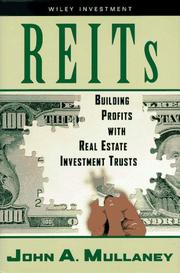
REITs
Early practitioner introduction to the vehicle.
Summary
The reference has not verified this book in detail; the summary states only what the title, author and subject establish.
John Mullaney wrote this as a practitioner introduction to real estate investment trusts for investors and advisers, covering what they are, how they are structured and how to analyse them.
The content covers the legal requirements for REIT status, principally the distribution of most taxable income and the restrictions on asset composition and income sources; the property sectors and their differing economics; the analytical measures used in the sector, particularly funds from operations and adjusted funds from operations, which adjust reported earnings for real estate depreciation; the assessment of management quality and of the property portfolio; leverage and its role; and valuation approaches including net asset value and multiples of funds from operations.
The reference has not verified this book in detail, and this entry describes the standard analytical content of the sector rather than the author's specific arguments. Readers should note that the book was published in 1997, before the sector's substantial growth, before the modern REIT era's consolidation, before REITs were added to the major equity indices in 2001, and before the leverage and refinancing stresses of 2008.
Key takeaways 6
- REIT status requires distributing most taxable income, which forces the company to raise external capital for any growth.
- Reported earnings understate REIT cash generation because real estate depreciation is an accounting charge rather than an economic one.
- Funds from operations adds depreciation back to earnings and is the sector's standard measure, though its definition varies between companies.
- Adjusted funds from operations subtracts recurring capital expenditure and is closer to distributable cash than funds from operations is.
- Property sectors differ enough in lease length and tenant credit that comparing REITs across sectors on the same multiples is uninformative.
- Leverage levels and debt maturity profiles determine which REITs survive a refinancing market closure.
Who should read it
Investors new to listed property who want the sector's analytical vocabulary, with the caveat that this entry is not verified in detail and the book is dated.
Where it sits in the reference 2
Similar books 6
Chosen by shared topics, the entries that hold them, and the people who recommended both.




