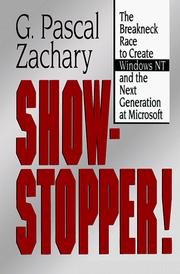
Show-Stopper!
The building of Windows NT; a classic of software-project reporting.
Summary
Pascal Zachary, then a Wall Street Journal reporter, was given access to the Windows NT development team at Microsoft and produced this account of the project from 1988 to its release in 1993. It is one of the few detailed narratives of a large software project written from inside.
The project's origin was Microsoft's need for an operating system it owned outright, without the OS/2 relationship with IBM and without the DOS lineage. Bill Gates recruited Dave Cutler from Digital Equipment Corporation, where he had led the VMS operating system, along with several of his colleagues. Zachary follows the team as it grew from a handful of people to several hundred, and documents Cutler's management: his contempt for people he considered incompetent, his insistence on technical decisions, the personal cost to the team, and the repeated schedule slips.
The engineering content covers the architectural decisions, including portability across processor architectures, the microkernel-influenced design, the addition of a Windows compatibility layer after the OS/2 personality was deprioritised, and the performance and memory problems that resulted from the design choices. Zachary also covers the daily build and test discipline that Microsoft developed on this project, which became standard industry practice. The book is journalism from inside a single project rather than an analysis of software development. Its account of what a five-year, several-hundred-person project actually costs the people doing it is unusually honest.
Key takeaways 7
- Microsoft recruited Cutler and his team from Digital in order to acquire an operating system capability it could own outright.
- Portability across processor architectures was designed in from the start, which cost performance and preserved the product's future.
- The daily build and test discipline developed on this project became standard practice across the software industry.
- Adding a Windows compatibility layer late changed the product's identity and its resource requirements substantially.
- Zachary documents that the project's schedule estimates were wrong by years and that nobody involved expected otherwise.
- Cutler's technical authority held the architecture together and made the team dependent on one person's judgement.
- Large software projects impose personal costs on their teams that the industry treats as the price of participation.
Who should read it
Engineering leaders and founders who want a documented account of a large multi-year software project, including its schedule failures and human costs.
Where it sits in the reference 2
Similar books 6
Chosen by shared topics, the entries that hold them, and the people who recommended both.