Strategy, Structure, and Economic Performance
Harvard Business School doctoral dissertation series; not machine-verified.
Summary
Richard Rumelt's doctoral dissertation tested whether a firm's diversification strategy predicts its financial performance, using a sample of large American corporations across two decades. It is one of the foundational empirical studies in strategic management.
Rumelt's contribution was a classification scheme with more discrimination than the crude distinction between focused and diversified firms. He divided companies into single business, dominant business, related business and unrelated business categories, and further split related business into related-constrained, where all units share a common resource or skill, and related-linked, where units connect in a chain without a common core. He then compared financial performance across categories, controlling for industry.
The finding that made the study famous is that related-constrained diversifiers outperformed both focused firms and unrelated conglomerates. Firms that diversified into businesses sharing a central skill or resource earned higher returns than either firms that did not diversify at all or firms that assembled unrelated portfolios. The result gave empirical support to the argument that diversification creates value only through shared capability, which became the basis for the resource-based view of the firm that Rumelt and others developed subsequently. The methodology has been criticised, particularly the subjectivity of the classification and the possibility that industry composition rather than strategy drove the results, and later replications have produced mixed findings. The framework remains standard.
Key takeaways 7
- Firms diversifying into businesses that share a common skill or resource outperformed both focused firms and unrelated conglomerates.
- Unrelated diversification produced no performance advantage over focused operation, which undermines the portfolio management justification for conglomerates.
- Diversification categories require distinguishing between businesses sharing a common core and businesses linked only in a chain.
- Rumelt found that industry effects explain part but not all of the performance differences between diversification strategies.
- The result implies that corporate strategy creates value by transferring capability between businesses rather than by allocating capital between them.
- Classification of a firm's diversification strategy requires judgement, which is the study's principal methodological weakness.
- Rumelt's later work found that firm-specific effects explain more performance variance than industry membership does.
Who should read it
Investors and executives evaluating diversification and conglomerate structures who want the founding empirical study on when related diversification pays.
About Richard Rumelt
Harry and Elsa Kunin Professor Emeritus of Business and Society, UCLA Anderson School of Management; previously INSEAD and Harvard Business School
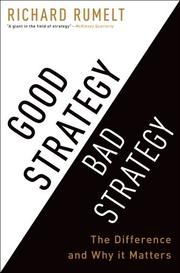
Good Strategy Bad Strategy is the standard reference for what a strategy actually is, and his 1974 diversification study founded an empirical literature.
Where it sits in the reference 2
Similar books 6
Chosen by shared topics, the entries that hold them, and the people who recommended both.