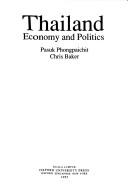
Thailand: Economy and Politics
The pre-crisis baseline: how the boom economy was actually structured.
Summary
Pasuk and Baker's general history of modern Thailand covers the country from the late nineteenth century through the mid-1990s, tracing the connections between economic development and political structure. It is the standard scholarly work on the subject.
The historical narrative covers the Bangkok state's consolidation of the territory, the rice export economy and the Chinese commercial class that organised it, the 1932 end of absolute monarchy, the military governments and their relationship with American aid during the Cold War, the industrialisation from the 1960s, the growth of a business class and its entry into electoral politics, and the recurring pattern of military intervention followed by civilian government.
The analytical spine concerns who holds power and how it changes. The authors trace the shift from a bureaucratic polity in which the military and civil service governed, through the emergence of provincial business interests who bought their way into parliament, to the metropolitan business class that grew with the boom. They also cover the rural economy, agricultural policy and the terms on which the countryside was taxed to fund urban industrialisation, and the position of the monarchy as an institution whose political role expanded through this period.
The book was published in 1995 and later editions extended it. The reference has not verified its specific data. It is a scholarly history rather than an investment or policy text, and its use to an investor is as background on how Thai political and business power is structured, which subsequent events have repeatedly demonstrated matters more than economic policy.
Key takeaways 7
- Thailand was governed for decades by a bureaucratic polity of military and civil servants rather than by any electoral or business constituency.
- Provincial business interests entered national politics by purchasing parliamentary seats, which changed what government was for without changing its form.
- The rural economy was taxed through rice export controls to fund urban industrialisation, which shaped the income gap that later defined Thai politics.
- An ethnic Chinese commercial class organised the export economy and assimilated politically in a way that did not occur elsewhere in Southeast Asia.
- Military intervention followed by civilian government has been a recurring cycle rather than a series of separate events.
- American Cold War aid and military spending funded infrastructure and shaped the state's institutional development for two decades.
- The monarchy's political role expanded substantially during the second half of the twentieth century rather than being a continuous inheritance.
Who should read it
Investors and analysts who need background on how political and business power is structured in Thailand.
About Pasuk Phongpaichit
Emeritus professor of economics at Chulalongkorn University in Bangkok; writes on Thailand's economy, politics, corruption and inequality.
The Thailand books track one economy through a credit-fuelled boom, the 1997 devaluation and the political conflict that followed, measuring the informal economy and the business-political networks instead of assuming them away. Anyone underwriting Southeast Asian exposure finds here the local mechanics linking capital, patronage and policy.
Where it sits in the reference 4
Similar books 6
Chosen by shared topics, the entries that hold them, and the people who recommended both.