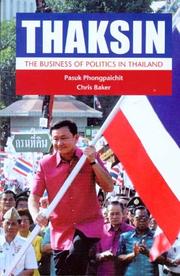
Thaksin
Telecoms billionaire turned prime minister; the clearest study of business-politics fusion in Thailand.
Summary
Phongpaichit and Baker wrote a political and business biography of Thaksin Shinawatra, covering his rise from police officer to telecommunications magnate to prime minister.
The business sections are the most useful for investors. The authors trace how Thaksin built Shin Corporation on state concessions: pager services, mobile telephony through the AIS concession, satellite operations through Shinawatra Satellite, and cable television. Each business depended on a licence or concession granted by the state, and the authors argue that the ability to obtain and to renegotiate these was the actual competitive asset. They document the terms and the subsequent amendments, and connect the company's value to political access.
The political sections cover the founding of Thai Rak Thai, the 2001 election, and the policy programme: universal healthcare at low cost, village funds providing credit outside the banking system, debt relief for farmers, and support for small enterprise. The authors argue that Thaksin was the first Thai politician to build a genuine mass electoral base by delivering material benefits to rural voters, and that this is why the Bangkok establishment opposed him. They also document the war on drugs with its extrajudicial killings, the handling of the southern insurgency, the pressure on media, and the concentration of business and political power in one person.
The book was published in 2004, before the 2006 coup, and was revised in later editions.
The authors write critically of both Thaksin and the establishment that removed him, which makes it more useful than the partisan accounts on either side. It is specific about business structures in a way that political biographies usually are not.
Key takeaways 7
- Shin Corporation was built on state telecommunications concessions, so political access rather than operational capability was the competitive asset.
- Concession terms were renegotiated during Thaksin's political career in ways that benefited his companies.
- Thaksin was the first Thai politician to win a parliamentary majority by delivering material benefits to rural voters.
- Universal healthcare and village credit funds created a durable electoral base that Bangkok-based parties could not match.
- Concentrating business ownership and executive political power in one person produced conflicts that the constitution did not anticipate.
- The Bangkok establishment's opposition was driven by the loss of political control rather than by the corruption allegations alone.
- Business empires built on state concessions are vulnerable to political change in exactly the way that ordinary operating businesses are not.
Who should read it
Investors and operators in Thailand and comparable markets who need to understand how concession-based businesses and political power interact.
About Pasuk Phongpaichit
Emeritus professor of economics at Chulalongkorn University in Bangkok; writes on Thailand's economy, politics, corruption and inequality.
The Thailand books track one economy through a credit-fuelled boom, the 1997 devaluation and the political conflict that followed, measuring the informal economy and the business-political networks instead of assuming them away. Anyone underwriting Southeast Asian exposure finds here the local mechanics linking capital, patronage and policy.
Where it sits in the reference 3
Similar books 6
Chosen by shared topics, the entries that hold them, and the people who recommended both.