The Accidental Billionaires
Dramatised founding story; source for The Social Network.
Summary
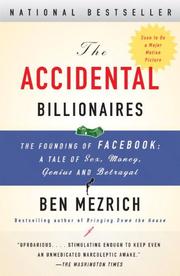
Mezrich wrote a narrative account of Facebook's founding, built primarily on the cooperation of Eduardo Saverin, the co-founder whose stake was diluted and who sued the company. It became the basis for the film The Social Network.
The story covers Harvard in 2003 and 2004, the Facemash incident, the ConnectU dispute with the Winklevoss twins and Divya Narendra, the launch and rapid campus-by-campus expansion, the move to Palo Alto, Sean Parker's involvement, the Thiel investment, and the recapitalisation that reduced Saverin's holding.
The method is the problem. Mezrich writes what he describes as dramatic non-fiction: he reconstructs scenes he did not witness, invents dialogue, attributes internal thoughts to people he did not interview, and composites events. Mark Zuckerberg and most of the company declined to participate, so the account rests heavily on one party to a lawsuit. Facebook disputed the book's accuracy, and Mezrich acknowledged in the text that scenes were recreated.
As business history it is unreliable. The broad sequence of events is corroborated by court filings and other reporting, but specific scenes, motivations and conversations should not be treated as evidence. Anyone wanting the actual history should read Kirkpatrick's The Facebook Effect or Levy's Facebook, both of which had company access and worked from documents.
What the book does convey accurately, because it is visible in the record, is the speed of the early expansion, the effect of the exclusivity strategy in launching campus by campus, and the mechanics by which founder equity is diluted when the company recapitalises and one founder is not present for the decision.
Key takeaways 7
- Facebook expanded campus by campus, using exclusivity and existing social networks rather than open registration.
- Founder equity can be substantially diluted through a recapitalisation when one founder is not part of the decision.
- Early informal founder arrangements without documented vesting or transfer restrictions create the disputes that follow success.
- The ConnectU claim rested on an agreement to develop a competing product, which is why it produced a settlement rather than a dismissal.
- Sean Parker's contribution was knowledge of how founders lose control, which shaped the company's early governance choices.
- The account rests on one party to litigation and reconstructs scenes the author did not witness, so specific claims are unverifiable.
- Reconstructed dialogue and attributed internal thoughts make this unsuitable as a source for anything but the general sequence.
Who should read it
Readers who want the popular narrative of Facebook's founding, provided they use Kirkpatrick or Levy for anything factual.
About Ben Mezrich
American author of dramatised nonfiction about card counting, Facebook's founding, the Winklevoss bitcoin position and the GameStop squeeze.
The books reconstruct financial episodes scene by scene from participant interviews, which is why several became films and why they reach readers who never open a market history. Read them as accounts told from one side, with dialogue and detail reconstructed rather than documented.
Where it sits in the reference 3
Similar books 6
Chosen by shared topics, the entries that hold them, and the people who recommended both.