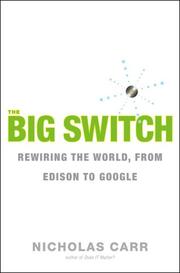
The Big Switch
Computing as a utility; the argument that anticipated the cloud model.
Summary
Carr argues that computing is following the path electricity took: from something each organisation generated for itself to a utility supplied over a network by specialised providers at a scale no individual user could match.
The historical parallel occupies the first half. Factories in the nineteenth century generated their own power with waterwheels and steam engines, and each had a plant and staff to run it. Once alternating current made long-distance transmission viable, central generation became so much cheaper that private generation disappeared within about two decades. Carr argues the same economics apply to computing: data centres achieve utilisation, purchasing and operational efficiencies that an individual company's servers cannot, and the internet supplies the transmission.
His prediction, made in 2008, was correct. Corporate data centres have largely been replaced by cloud providers, and the internal information technology function's role has changed as he described.
The second half concerns consequences and is more speculative. Carr argues that utility computing concentrates enormous power in a small number of providers, that the economics produce fewer jobs than the industries they replace, that the personalisation the technology enables fragments shared culture and public discourse, and that the aggregate of individual choices produces outcomes nobody chose.
The utility argument was well made and correct. The social chapters are essayistic and their predictions are mixed. The book's value now is as a demonstration that a structural economic argument about technology can be correct while its social consequences remain unclear.
Key takeaways 7
- Computing follows the path electricity took, from private generation by each user to utility supply by specialised providers at unmatched scale.
- Central generation displaced private power within about two decades once transmission made it viable, which sets the base rate for such transitions.
- Data centre operators achieve utilisation, purchasing and operational efficiencies that an individual company's own servers cannot approach.
- Utility computing concentrates enormous power in a small number of providers, which is a structural consequence of the economics rather than a policy choice.
- The information technology function's role changes from operating infrastructure to selecting and integrating services once the utility model prevails.
- Digital industries generate far fewer jobs than the industries they replace, because their scale economics do not require proportionate labour.
- A structural economic argument about a technology can be correct while its social consequences remain genuinely unclear.
Who should read it
Operators and investors interested in the utility computing transition and in the pattern of infrastructure centralising once transmission is solved.
Where it sits in the reference 2
Who recommended it 1
Similar books 6
Chosen by shared topics, the entries that hold them, and the people who recommended both.

