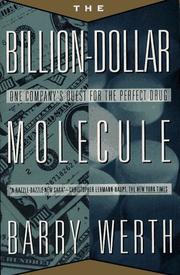
The Billion-Dollar Molecule
Vertex from the inside; the classic account of drug discovery economics.
Summary
Werth was given access to Vertex Pharmaceuticals during its first years and produced a detailed account of drug discovery as it actually happens, following Joshua Boger's founding of the company in 1989 and its attempt to design a drug rationally from protein structure rather than by screening compounds.
The scientific approach is the subject. Structure-based drug design proposed to determine a target protein's three-dimensional structure and then design a molecule to fit it, which would replace the empirical screening of thousands of compounds that the industry relied on. Vertex applied this to FK-506 binding protein and to immunosuppression, and Werth follows the chemistry, the crystallography and the competition with Merck's team on the same target.
The business material covers what a research company must do before it has a product: raise capital repeatedly on scientific promise, manage a scientific staff whose incentives include publication and priority, decide what to disclose and when, and sustain the organisation through years in which nothing reaches a patient.
Werth's access was unusual and the scientific detail is real rather than gestured at. The book ends in the early 1990s, long before Vertex succeeded with hepatitis C and then with cystic fibrosis treatments that made it a large company, so it documents the difficult period without the resolution. Rational drug design also proved far harder than the founders expected, which the book conveys accurately without knowing how the question would be settled.
Key takeaways 7
- Structure-based drug design proposed to determine a protein's three-dimensional structure and design a molecule to fit, replacing empirical screening of thousands of compounds.
- Rational design proved far harder than its advocates expected, and the industry continued to rely on screening for decades afterwards.
- A research company must raise capital repeatedly on scientific promise alone through years in which nothing reaches a patient.
- Scientific staff have incentives including publication and priority that conflict directly with a company's need for secrecy and patent position.
- Competition on the same target between a startup and a large pharmaceutical company is a race in which the larger firm has more resources and less urgency.
- Deciding what to disclose and when is a strategic decision that determines both the patent position and the ability to recruit scientists.
- The book covers the difficult early period without the resolution, since Vertex's successful products came two decades later.
Who should read it
Founders and investors in deep science companies who want a detailed account of research-stage company building before any product exists.
Where it sits in the reference 2
Who recommended it 1
Similar books 6
Chosen by shared topics, the entries that hold them, and the people who recommended both.