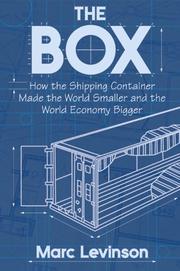
The Box
How the container turned ships into standardised, financeable assets.
Summary
Levinson, an economist and former journalist, writes the history of the shipping container from Malcom McLean's first converted tanker voyage in 1956 to the modern global supply chain. His argument is that the container reduced freight costs so dramatically that it changed what could be manufactured where, and that this was the enabling condition for globalised production.
The history covers the pre-container port, where longshoremen loaded mixed cargo by hand at costs that could exceed twenty-five percent of a shipment's value and where a ship might spend more time in port than at sea. McLean was a trucking operator rather than a shipping man, and Levinson argues that this outsider position is why he saw the problem as moving cargo rather than as moving ships.
The institutional obstacles occupy much of the book. Standardisation of container dimensions took over a decade of disputes among competing manufacturers, railroads and regulators. Longshoremen's unions in New York and on the West Coast negotiated settlements that traded job losses for compensation, and Levinson documents the destruction of employment in port cities. Ports that invested early, including Oakland and Seattle, took traffic permanently from New York and London.
The economic analysis shows that the benefits took roughly two decades to appear, that many early adopters lost money, and that the gains went to shippers and consumers rather than to the shipping lines, which have been chronically unprofitable. The book is dense with institutional and regulatory detail that some readers will find slow. It ends before the 2010s consolidation and the supply chain disruptions of recent years. It is the best available case study of an innovation whose value depended entirely on complementary changes elsewhere.
Key takeaways 8
- The container reduced freight costs enough to change where goods could be manufactured, which made globalised production economically possible.
- Before containerisation, loading and unloading mixed cargo by hand could consume more than a fifth of a shipment's value and kept ships in port longer than at sea.
- McLean saw the problem correctly because he came from trucking and thought about moving cargo rather than about operating ships.
- The innovation's value depended entirely on complementary changes in ports, ships, trucks, railways and customs procedures, none of which the inventor controlled.
- Standardising container dimensions took more than a decade of disputes and was the precondition for any of the benefits appearing.
- The economic gains took around two decades to materialise, and many of the early investors lost money before the system worked.
- Ports that invested early captured traffic permanently from established ports, which destroyed the economies of cities including New York and London as ports.
- The value created went to shippers and consumers rather than to the shipping lines, which have remained chronically unprofitable.
Who should read it
Investors and founders working on infrastructure or standards-dependent innovations, who need a case where the value took twenty years and depended on others.
Where it sits in the reference 6
Who recommended it 4 · 2 direct
Similar books 6
Chosen by shared topics, the entries that hold them, and the people who recommended both.