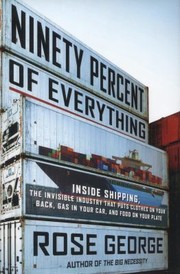
Ninety Percent of Everything
Aboard a Maersk box ship; the economics of the trade Denmark dominates.
Summary
George sailed on a Maersk container ship from Rotterdam to Singapore and used the voyage to report on the container shipping industry: how ships are crewed, registered, insured and regulated, and why an industry that moves the great majority of world trade is close to invisible to the people who depend on it.
The reporting covers flags of convenience and the regulatory arbitrage they enable, the conditions and legal position of Filipino and Eastern European seafarers, abandonment of crews by insolvent owners, piracy off Somalia including detailed accounts of hostage cases, the environmental cost of bunker fuel and the effect of ship noise on whales, and the way maritime law leaves sailors outside most national jurisdictions. She interviews crew, shipowners, insurers, naval officers and rescue organisations.
The book is journalism, not economics. It does not analyse freight rates, shipping cycles, charter markets or the capital cycle that makes the industry chronically unprofitable, so an investor looking for the economics should go elsewhere. What it does supply is a grounded picture of the physical and legal infrastructure that supply chains depend on, which is directly relevant to anyone whose business assumes ocean freight works. Some of the specifics have dated: Somali piracy subsided after armed guards and naval patrols became standard, sulphur emission rules tightened in 2020, and the pandemic exposed crew change and port congestion problems the book anticipates only partly.
Key takeaways 7
- Ocean shipping carries roughly ninety percent of world trade while operating almost entirely outside public visibility and national regulation.
- Flags of convenience allow owners to select the labour, safety and tax regime that applies to their vessels, which drives standards toward the weakest available.
- Seafarers work under contracts and jurisdictions that leave them with little practical recourse when owners abandon them or when they are injured.
- The cost of moving goods by sea is so low relative to product value that it has effectively removed distance as a constraint on where things are made.
- Somali piracy was a commercial system with negotiated ransoms and established intermediaries, not opportunistic robbery.
- Bunker fuel used by container ships is among the dirtiest fuel in commercial use, and shipping's emissions were excluded from major climate agreements.
- Maritime insurance and salvage law operate on centuries-old principles that determine outcomes more than modern regulation does.
Who should read it
Operators whose businesses depend on ocean freight and who want to understand the labour, legal and physical realities behind the logistics line in their model.
Where it sits in the reference 4
Who recommended it 1 · 1 direct
Similar books 6
Chosen by shared topics, the entries that hold them, and the people who recommended both.