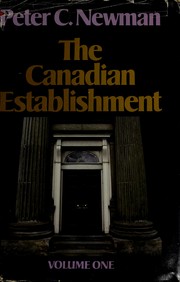
The Canadian Establishment
The founding map of who owns Canadian business.
Summary
Peter Newman, a Canadian journalist and editor, wrote this portrait of the country's business elite in 1975, based on several hundred interviews with the people concerned. It became one of the best-selling Canadian non-fiction books and established Newman's position as the chronicler of Canadian corporate power.
The method is descriptive and sociological rather than analytical. Newman maps the families, firms and institutions that controlled Canadian business, the schools and clubs through which they connected, the boards on which they overlapped, and the relationships between Toronto and Montreal, English and French, and Canadian and American capital. He treats the concentration of Canadian corporate ownership in a small number of families as the country's defining business characteristic.
The book is a period document. Many of the institutions it describes have been transformed, the families it names have declined or dispersed, and Canadian corporate ownership has changed substantially through globalisation and through the growth of the pension funds. Newman is a journalist writing about people he knew, and the tone is closer to social observation than to investigation. Its lasting interest is as a record of how concentrated business ownership operated in a middle-sized developed economy.
Key takeaways 6
- Canadian corporate ownership in the 1970s was concentrated in a small number of families connected through boards, schools and clubs.
- Newman treats social institutions rather than formal corporate structures as the mechanism through which the elite coordinated.
- Overlapping board memberships gave a small group visibility across most of the Canadian economy.
- The division between Toronto and Montreal capital, and between English and French business, structured Canadian corporate life.
- Canadian business elites defined themselves partly in relation to American capital, which owned much of the country's industry.
- The book is descriptive rather than analytical and records a structure that subsequently changed substantially.
Who should read it
Readers interested in how concentrated business ownership operated in a middle-sized developed economy, as a period document.
Where it sits in the reference 2
Similar books 6
Chosen by shared topics, the entries that hold them, and the people who recommended both.