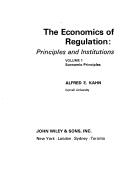
The Economics of Regulation
The standard theory of rate base, allowed return and marginal-cost pricing.
Summary
Kahn wrote this two-volume work as the standard economic treatment of regulated industries, and he later applied its conclusions himself as chairman of the Civil Aeronautics Board, where he dismantled airline regulation.
The first volume covers principles. Kahn works through the economic case for regulating natural monopolies, meaning industries where a single firm can serve the market at lower cost than several, and then examines the pricing rules that follow. He develops the case for marginal cost pricing as the efficiency benchmark, then works through why regulated firms cannot generally price at marginal cost when average cost exceeds it, and examines the alternatives including two-part tariffs, peak-load pricing, and Ramsey pricing where markups vary inversely with demand elasticity. He treats the problem of common costs allocated across services, which he argues is analytically insoluble and therefore decided politically.
The second volume covers institutional practice and its failures. Rate of return regulation on the rate base creates the incentive, identified by Averch and Johnson, to over-invest in capital because the allowed return applies to the asset base. Regulatory lag alters incentives in ways the rules do not intend. Regulators extend their control beyond natural monopoly segments into competitive ones, which protects incumbents without any efficiency justification. Cross-subsidy between customer classes becomes entrenched and creates constituencies that resist reform.
Kahn's practical conclusion, which he acted on, is that regulation should apply only where market structure genuinely requires it, and that industries without natural monopoly characteristics, including airlines and trucking, should not be regulated at all.
The work is technical and written for economists. It is dated in its industry examples, and the subsequent experience of deregulation, including airline concentration and the electricity market failures, complicates the confidence of its conclusions.
Key takeaways 7
- Regulation is economically justified only where a single firm can serve the market at lower cost than several can.
- Marginal cost pricing is the efficiency benchmark, and every departure from it must be justified by the need to cover total cost.
- Peak-load pricing is required wherever capacity costs are driven by demand at particular times, and flat rates misallocate capacity.
- Rate of return regulation applied to the asset base gives firms an incentive to over-invest in capital.
- Allocating common costs across services has no economically correct answer, so the allocation is decided politically.
- Regulators extend control from genuinely monopolistic segments into competitive ones, which protects incumbents without efficiency justification.
- Cross-subsidies between customer classes create constituencies that make reform politically difficult regardless of the economics.
Who should read it
Economists, regulators and operators in regulated industries who need the analytical framework for pricing and for judging when regulation is justified.
Where it sits in the reference 3
Similar books 6
Chosen by shared topics, the entries that hold them, and the people who recommended both.