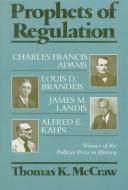
Prophets of Regulation
Pulitzer history of the people who built American utility regulation.
Summary
McCraw examines American regulation through four figures who shaped it, covering roughly a century. The book won the Pulitzer Prize for history.
Charles Francis Adams Jr, working on the Massachusetts railroad commission in the 1870s, developed the sunshine commission model, which had no coercive power and relied on publicity and expert investigation to change behaviour. McCraw argues this worked in a limited setting and failed once the railroads' national scale outgrew it.
Louis Brandeis argued against bigness as such, holding that large firms were inefficient beyond a certain scale and dangerous to democratic society, and shaped both antitrust doctrine and the disclosure principle in securities law. McCraw is critical here: he shows that Brandeis's economic claims about scale were often wrong, that his opposition to size did not rest on evidence, and that his commitment to small enterprise sometimes protected inefficiency.
James Landis built the administrative agency as an institution, arguing that expert commissions insulated from politics could regulate complex industries better than courts or legislatures. McCraw traces both the design of the Securities and Exchange Commission and Landis's later disillusionment, when he concluded that agencies were captured by the industries they regulated.
Alfred Kahn, as an economist chairing the Civil Aeronautics Board, used economic analysis to conclude that airline regulation protected incumbents and raised fares without any natural monopoly justification, and then dismantled the agency he ran.
McCraw's general argument is that regulation succeeds when it is grounded in the actual economic structure of the industry, and fails when it rests on political preference or on assumptions about scale that the industry does not exhibit.
The book was written in 1984 during the deregulation period and reflects that moment's confidence. Subsequent experience with airline concentration, financial deregulation and the 2008 crisis complicates its conclusions, and readers should hold that in mind.
Key takeaways 7
- Regulation succeeds when it is grounded in the actual economic structure of an industry and fails when it rests on political preference.
- The sunshine commission model relied on publicity and expert investigation rather than coercive power, and worked only at local scale.
- Brandeis opposed large firms on grounds that were political rather than economic, and his claims about scale efficiency were frequently wrong.
- Disclosure rather than merit review became the organising principle of American securities regulation, and it came from Brandeis.
- Landis designed the independent expert agency and later concluded that such agencies are captured by the industries they regulate.
- Airline regulation raised fares and protected incumbents in an industry with no natural monopoly characteristics.
- An economist running a regulatory agency dismantled it because the analysis showed the regulation had no economic justification.
Who should read it
Founders, investors and operators in regulated industries who want to understand what determines whether a regulatory regime serves its stated purpose.
Where it sits in the reference 3
Similar books 6
Chosen by shared topics, the entries that hold them, and the people who recommended both.