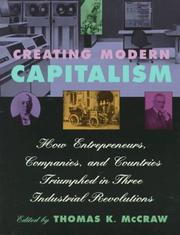
Creating Modern Capitalism
National business systems compared through the firms that defined them.
Summary
McCraw edited this volume, written by Harvard Business School faculty, examining how Britain, Germany, Japan and the United States each developed distinct forms of capitalism. Each national section combines an analytical chapter with biographical case studies of representative entrepreneurs and firms.
The comparative argument is that capitalism took different institutional forms in each country, determined by the timing of industrialisation, the role of the state, the structure of finance and the education system. Britain industrialised first with family firms and personal capitalism, which became a disadvantage when scale mattered. Germany industrialised later with bank finance, technical education and cartels, producing large firms with close bank relationships. Japan industrialised through state direction, the zaibatsu and later keiretsu groupings, and organisational forms adapted from Western models. The United States developed managerial capitalism with professional managers, dispersed ownership and antitrust constraint on combination.
The case studies include Josiah Wedgwood, Henry Bessemer, the Rothschilds, Werner Siemens, the German chemical industry, the Japanese trading companies, Toyota, Henry Ford, Alfred Sloan and others.
The framework draws heavily on Chandler, who contributed to the volume, and the British decline argument carries his interpretation with its associated criticisms. The book is a teaching text and the chapters vary in depth. Its value is the comparative frame combined with concrete cases, which shows that the institutional arrangements investors treat as natural are national and contingent.
Key takeaways 7
- Capitalism took distinct institutional forms in Britain, Germany, Japan and the United States, determined by industrialisation timing, finance structure and the state's role.
- Britain's family firm structure was an advantage during early industrialisation and a disadvantage once scale and professional management determined competitiveness.
- German industry developed with bank finance, technical education and legal cartels, which produced large firms capable of long-horizon investment.
- Japanese industrialisation was state-directed and organised through business groups, which supplied capital and coordination that markets did not provide.
- American managerial capitalism separated ownership from control and constrained combination through antitrust, which produced professional management as a profession.
- Entrepreneurs operate within national institutional structures that determine which strategies are available to them.
- The institutional arrangements of any national capitalism appear natural from inside and are contingent when compared across countries.
Who should read it
Investors and operators working across countries who want the comparative institutional history of how different capitalisms developed.
Where it sits in the reference 2
Who recommended it 1 · 1 direct
Similar books 6
Chosen by shared topics, the entries that hold them, and the people who recommended both.