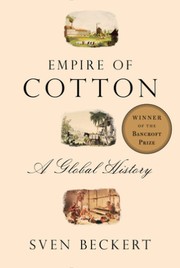
Empire of Cotton
One commodity chain as the whole story of industrial capitalism.
Summary
Beckert, a Harvard historian, wrote a global history of cotton from the ancient world to the present, using the commodity to trace the development of capitalism itself.
His central analytical contribution is the concept of war capitalism, which he distinguishes from industrial capitalism. War capitalism preceded and enabled industrialisation, and it operated through violence rather than through markets: the seizure of land from indigenous peoples in the Americas, the enslavement of Africans to work it, the armed domination of trade routes, and the destruction of competing production, particularly the Indian cotton textile industry which was the world's largest before British policy dismantled it. Beckert argues that European industrialisation depended on this: cheap slave-grown raw cotton, captive markets created by force, and capital accumulated through the trade.
The industrial narrative traces the mechanisation of spinning and weaving in Britain, the concentration of production in Lancashire, the American South's emergence as the dominant supplier, the disruption of the American Civil War and the global scramble for alternative supply in India, Egypt and Brazil that followed, and the subsequent reorganisation of production.
The later sections cover the movement of manufacturing from Britain to continental Europe, to the American South, to Japan, and eventually to China, India, Bangladesh and Vietnam, and argue that the industry has repeatedly relocated to wherever labour is cheapest and most controllable, which is the pattern rather than an exception.
Beckert also documents the state's role throughout: tariffs, colonial policy, infrastructure and the coercion of labour were state actions without which the industry would not have developed as it did.
The book is long and its central claim, that slavery and coercion were constitutive of capitalism rather than incidental to it, is contested by economic historians who dispute the quantitative significance. The global scope and the documentation are widely admired.
Key takeaways 7
- European industrialisation depended on cheap slave-grown raw cotton, on captive markets created by force, and on capital accumulated through that trade.
- War capitalism operating through land seizure, slavery and armed trade domination preceded and enabled industrial capitalism.
- India had the world's largest cotton textile industry before British policy dismantled it in favour of Lancashire production.
- The American Civil War's disruption of cotton supply triggered a global scramble that reorganised production across India, Egypt and Brazil.
- Cotton manufacturing has repeatedly relocated to wherever labour is cheapest and most controllable, which is the industry's persistent pattern.
- State action through tariffs, colonial policy, infrastructure and labour coercion was constitutive of the industry rather than incidental.
- The claim that coercion was constitutive of capitalism rather than incidental is contested by economic historians on quantitative grounds.
Who should read it
Readers who want a global commodity history that connects supply chains, state power and labour coercion across four centuries.
Where it sits in the reference 2
Similar books 6
Chosen by shared topics, the entries that hold them, and the people who recommended both.