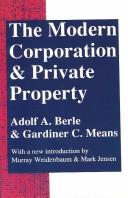
The Modern Corporation and Private Property
Named the separation of ownership and control; every governance argument descends from it.
Summary
Adolf Berle, a lawyer, and Gardiner Means, an economist, published this in 1932 and it established the framework in which corporate governance has been discussed since.
Their empirical finding, which was original research, is that ownership of large American corporations had become so dispersed that no shareholder or group held enough to control the company. They classified the two hundred largest non-financial corporations by control type and found that a substantial share were controlled by management rather than by owners. This separation of ownership from control is the book's central concept.
The consequences they draw are the beginning of agency theory, though not in that vocabulary. Managers who do not own the firm have interests that differ from those of the shareholders who do, and the mechanisms available to shareholders, principally the proxy vote, are ineffective because dispersed owners have no incentive to inform themselves. Berle and Means also argue that the corporation had become a social institution whose power exceeded that of many states, and that its legitimacy could no longer rest on the property rights of its owners since those owners no longer controlled it. Berle later engaged in a famous exchange with Merrick Dodd about whether managers owe duties to shareholders alone or to a wider set of constituencies. The empirical claim about ownership dispersion has been reversed by the growth of institutional investors, which concentrated shareholding again without solving the underlying problem.
Key takeaways 7
- Ownership of large American corporations had become dispersed enough that management controlled companies it did not own.
- Managers who do not own the firm have interests that differ systematically from those of the shareholders who do.
- Dispersed shareholders have no incentive to inform themselves, which makes the proxy vote an ineffective control.
- The corporation had become a social institution whose power exceeded that of many governments.
- Corporate legitimacy cannot rest on owners' property rights when those owners no longer exercise control.
- Berle and Means's classification of the largest corporations by control type was original empirical research, not assertion.
- Institutional investing has reconcentrated shareholding without resolving the separation the authors identified.
Who should read it
Investors and directors who want the founding statement of the corporate governance problem and the empirical work that established it.
Where it sits in the reference 2
Similar books 6
Chosen by shared topics, the entries that hold them, and the people who recommended both.