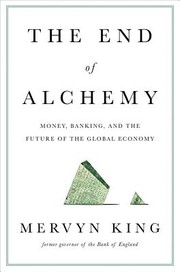
The End of Alchemy
By the Bank governor who hesitated; the lender-of-last-resort argument itself.
Summary
King, Governor of the Bank of England from 2003 to 2013, wrote this after leaving office as a diagnosis of what remains wrong with the financial system.
The alchemy of his title is the transformation banks perform: they take deposits that are safe, short-term and redeemable on demand, and hold assets that are risky, long-term and illiquid. King argues this is not a service that finance provides but a claim it cannot honour. In normal times the mismatch is invisible; when depositors want their money the assets cannot be sold at the values assumed. Every crisis is this same transformation failing, and the post-crisis reforms of capital and liquidity requirements do not remove it.
His second concept is radical uncertainty, taken from Knight and Keynes. Many important future states cannot be assigned probabilities, because we do not know what the possible outcomes are. King argues that both economic models and risk management systems assume probability distributions where none exist, that people cope by adopting narratives and heuristics, and that these coping mechanisms shift suddenly, which is what makes financial behaviour discontinuous.
His proposal is what he calls the pawnbroker for all seasons. Banks would pre-position collateral with the central bank, which would determine in advance how much it would lend against each asset. The total of these pre-committed amounts plus liquid assets would have to cover all demandable liabilities. This replaces both deposit insurance and the discretionary lender of last resort with a rule known in advance, and it caps the alchemy at a level the central bank has already accepted.
He also argues that the global imbalance between saving and consuming countries, and the euro's design, remain unaddressed. The proposal has not been adopted and has been criticised as costly and as difficult to implement across borders.
Key takeaways 7
- Banks transform safe redeemable deposits into risky illiquid assets, and this transformation is the source of every banking crisis.
- Capital and liquidity requirements constrain the transformation without removing it, so the reforms do not solve the problem.
- Radical uncertainty means many future states cannot be assigned probabilities, so risk models built on distributions describe something that does not exist.
- People cope with radical uncertainty through narratives that shift suddenly, which is why financial behaviour is discontinuous.
- Pre-positioning collateral with the central bank, with haircuts set in advance, would replace discretionary emergency lending with a known rule.
- Requiring demandable liabilities to be covered by liquid assets plus pre-committed central bank lending would cap the alchemy at a level already accepted.
- The imbalance between high-saving and high-consuming economies remains unresolved and will generate the next crisis.
Who should read it
Investors and operators in finance who want a central banker's diagnosis of what the post-crisis reforms did not fix, and a concrete alternative proposal.
Where it sits in the reference 3
Similar books 6
Chosen by shared topics, the entries that hold them, and the people who recommended both.