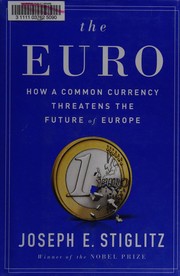
The Euro
The case that the currency union's design, not fiscal sin, caused the crisis.
Summary
Stiglitz argues that the euro was constructed on economic assumptions that were wrong, that it has damaged the economies of its members, and that Europe must either complete the union or dissolve it.
His diagnosis is that a single currency removes two adjustment mechanisms, the exchange rate and the national interest rate, without supplying replacements. In a functioning currency area, shocks that hit one region are absorbed by fiscal transfers, by labour mobility, and by a banking union that prevents local bank failures from becoming local fiscal crises. The eurozone had none of these. He argues further that the convergence criteria and the Stability and Growth Pact focused on fiscal deficits when the crisis countries other than Greece had low debt before 2008, and that the actual problem was private capital flows from the core to the periphery during the expansion.
His critique of the crisis response is that austerity applied to contracting economies deepened the contraction, that internal devaluation through wage reduction is slow and destructive compared with exchange rate adjustment, and that the programmes prioritised creditor repayment over recovery. He cites the fiscal multiplier evidence showing that the official models understated the contractionary effect.
His proposals are alternatives rather than a single plan: complete the union with a banking union including common deposit insurance, mutualised debt, a common fiscal capacity and a revised central bank mandate covering employment; or create a flexible euro system with sub-groupings; or permit an orderly dissolution.
Stiglitz argues one position and does not engage the case for the euro's benefits in trade, price stability and eliminated exchange rate risk. His counterfactuals are asserted rather than modelled. Since publication, the eurozone has added banking union elements and issued common debt in 2020, which addresses part of the critique.
Key takeaways 7
- A single currency removes exchange rate and interest rate adjustment without providing fiscal transfers, labour mobility or banking union to replace them.
- The crisis countries other than Greece had low public debt before 2008, so fiscal profligacy does not explain the crisis.
- Private capital flows from core to periphery during the expansion created the imbalances that the fiscal rules did not monitor.
- Internal devaluation through wage reduction is slower and more destructive than exchange rate adjustment.
- Fiscal multipliers during a contraction are far larger than the models used to design the austerity programmes assumed.
- Without common deposit insurance, a bank crisis becomes a sovereign crisis in the country where the bank is located.
- A currency union that cannot be completed politically should be dissolved in an orderly way rather than sustained by repeated crisis management.
Who should read it
Investors and operators with European exposure who want the case that the monetary union's design imposes ongoing costs, argued from a specific policy position.
About Joseph E. Stiglitz
Professor at Columbia University, Nobel laureate in economics, former World Bank chief economist and chair of the Council of Economic Advisers.
Globalization and Its Discontents documents from inside the institutions how IMF conditionality worked during the Asian and Russian crises, and why capital-account liberalisation ran ahead of the safeguards that would have made it survivable. The information-economics argument beneath the later books explains why markets with unequal information do not clear at efficient prices.
Where it sits in the reference 3
Similar books 6
Chosen by shared topics, the entries that hold them, and the people who recommended both.




