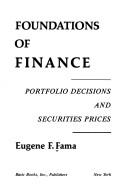
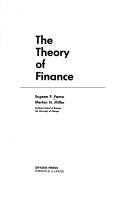
The Fama Portfolio: Selected Papers of Eugene F. Fama
Collected papers, edited by Cochrane and Moskowitz.
Summary
John Cochrane and Tobias Moskowitz edited this collection of Eugene Fama's papers, with introductions and commentary placing each in context. Fama received a Nobel prize in 2013 and the volume covers his work from the 1960s onward.
The papers include the original efficient markets survey and its later restatement, in which Fama sets out the joint hypothesis problem: any test of market efficiency is simultaneously a test of the asset pricing model used, so efficiency cannot be tested independently. They include the Fama and MacBeth cross-sectional regression method, still the standard technique for testing asset pricing models. They include the Fama and French three-factor model, which showed that size and book-to-market explain cross-sectional returns that the capital asset pricing model does not, and the later five-factor extension adding profitability and investment. They include the work on the term structure, on dividend policy, on corporate finance and on agency problems.
Cochrane's commentary is unusually good at explaining what each paper contributed and where the argument now stands. He is a Fama student and the volume is sympathetic. Fama's position, that the anomalies represent risk factors rather than mispricing, remains contested, and the book presents that argument at its strongest rather than adjudicating it. The volume is technical and aimed at readers with graduate finance training.
Key takeaways 7
- Any test of market efficiency is simultaneously a test of the asset pricing model used, so efficiency cannot be tested alone.
- Size and book-to-market explain cross-sectional stock returns that the capital asset pricing model cannot.
- Fama interprets the size and value factors as compensation for risk rather than as evidence of mispricing.
- The Fama and MacBeth regression method remains the standard technique for testing cross-sectional asset pricing models.
- Fama's five-factor model adds profitability and investment, which absorb several previously documented anomalies.
- Market efficiency is a model rather than a fact, and its value is as a benchmark against which deviations are measured.
- Cochrane's commentary presents the risk-based interpretation at its strongest rather than adjudicating between it and behavioural explanations.
Who should read it
Researchers and quantitative investors who want Fama's primary papers with expert commentary on what each established.
About Eugene F. Fama
Robert R. McCormick Distinguished Service Professor of Finance, University of Chicago Booth School of Business; Nobel laureate in economics 2013
The efficient-markets framework and the Fama-French factor models are the primary sources on which most modern empirical asset pricing is built.
Where it sits in the reference 2
Similar books 6
Chosen by shared topics, the entries that hold them, and the people who recommended both.