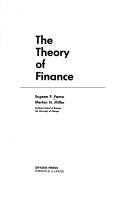
The Theory of Finance
Summary
Eugene Fama and Merton Miller wrote this graduate textbook in 1972, and it was the first attempt to present the emerging body of financial economics as a unified theory rather than as a set of separate topics.
The structure builds from the two-period consumption and investment model, in which an individual allocates resources between present and future consumption given a production opportunity set and a capital market. From this Fama and Miller derive the separation theorem: given a capital market, an individual's optimal production decision is independent of their consumption preferences, which is what justifies the firm maximising market value regardless of its owners' individual circumstances. This is the theoretical foundation of corporate finance.
The book then covers uncertainty, portfolio theory and the capital asset pricing model, and Miller's own work with Modigliani on capital structure and dividend policy, which established that under specified conditions the firm's financing decisions do not affect its value. The treatment is mathematical and rigorous and assumes a graduate audience. It is dated in that it precedes option pricing, agency theory, market microstructure and the entire empirical literature that followed, but the derivation of why value maximisation is the correct corporate objective is stated here more carefully than in any later treatment.
Key takeaways 7
- The separation theorem shows that a firm's optimal investment decision is independent of its owners' consumption preferences given a capital market.
- Value maximisation is the correct corporate objective because it makes every owner better off regardless of their individual circumstances.
- Under specified conditions the firm's capital structure does not affect its value, since investors can replicate any leverage themselves.
- Dividend policy is similarly irrelevant to value under those conditions, because investors can create their own income streams.
- The Modigliani and Miller propositions specify what would have to be true for financing to matter, which is how they are actually used.
- Financial theory can be derived from a small number of assumptions about markets and preferences rather than assembled from separate topics.
- The treatment precedes option pricing, agency theory and the empirical literature, which limits it as a current text.
Who should read it
Students and practitioners who want the rigorous derivation of why firms should maximise market value and of the capital structure propositions.
About Eugene F. Fama
Robert R. McCormick Distinguished Service Professor of Finance, University of Chicago Booth School of Business; Nobel laureate in economics 2013
The efficient-markets framework and the Fama-French factor models are the primary sources on which most modern empirical asset pricing is built.
Where it sits in the reference 2
Similar books 6
Chosen by shared topics, the entries that hold them, and the people who recommended both.