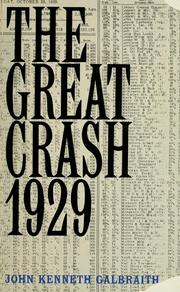
The Great Crash 1929
Still the standard account of speculative mania and its aftermath.
Summary
Galbraith reconstructs the American speculative boom of the late 1920s and the October 1929 collapse. He covers the Florida land bubble as a precursor, the growth of margin lending, the proliferation of investment trusts and holding companies with layered leverage, the specific days of the crash, and the aftermath through the Pecora hearings.
His analytical claims are about psychology and institutions rather than monetary policy. He argues that speculative episodes require a mechanism that lets people believe they are getting rich without producing anything, that leverage is always the amplifier, and that the pyramided investment trusts of 1929 were an especially efficient way to multiply leverage on leverage. He also argues that the crash did not cause the Depression by itself, but that the underlying economy had weaknesses, including bad income distribution, a poor corporate structure, a weak banking structure, a dubious foreign balance and poor economic intelligence, which the crash exposed. His concept of the bezel, the interval during which an embezzlement has occurred but has not yet been discovered and both parties feel wealthy, is the most quoted idea in the book.
The writing is ironic throughout and Galbraith is openly contemptuous of the bankers and officials he describes, which makes it entertaining and makes it argumentative history rather than neutral. Monetary historians, particularly Friedman and Schwartz, disagree fundamentally with his account of what turned a crash into a depression, and later work on the gold standard has changed the consensus further. Read it for the anatomy of speculative mania and the institutional detail, not as the settled explanation of the 1930s.
Key takeaways 7
- Speculative episodes require a mechanism that convinces participants they are becoming wealthy without production, and leverage is always the amplifier.
- The pyramided investment trusts of 1929 layered leverage on leverage, which meant a moderate fall in underlying prices wiped out the equity above them entirely.
- The crash did not cause the Depression by itself, but exposed structural weaknesses in income distribution, corporate structure, banking and the foreign balance.
- Financial authorities knew the boom was dangerous and did nothing, because the political cost of ending a boom falls on whoever ends it.
- At any time there is an inventory of undiscovered embezzlement, and it grows during booms and is revealed during busts.
- Public statements by officials and bankers during a collapse have no stabilising effect, and repeated reassurance accelerates the loss of confidence.
- Memory of financial disaster is short, and the conditions that produce speculation recur once the participants who lived through the last episode have left the market.
Who should read it
Investors who want the classic anatomy of a speculative mania and its leverage mechanics, read alongside a monetary account of the Depression itself.
About John Kenneth Galbraith
Harvard economist, wartime price administrator and US ambassador to India; died in 2006.
The Great Crash 1929 is the standard narrative of the boom, the leverage stacked inside investment trusts and the collapse that followed, written close enough to the events to use the participants directly. A Short History of Financial Euphoria condenses four centuries of speculation into a recurring pattern of leverage, the belief that a familiar instrument is genuinely new, and very short memory.
Where it sits in the reference 4
Who recommended it 1 · 1 direct
Similar books 6
Chosen by shared topics, the entries that hold them, and the people who recommended both.