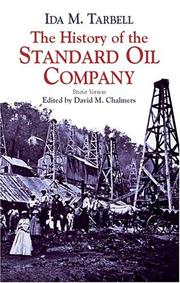
The History of the Standard Oil Company
The muckraking investigation that helped force the 1911 breakup.
Summary
Ida Tarbell published this as a series in McClure's Magazine between 1902 and 1904 and it remains the founding work of American investigative journalism. Her father had been an independent oil producer whose business was damaged by the events she describes, which she does not conceal.
Her research was extensive: court records, congressional and state investigation transcripts, company documents obtained from former employees, and interviews across the oil regions. The core of the indictment concerns transport. She documents the South Improvement Company scheme of 1872, under which railroads would grant Standard Oil rebates on its own shipments and drawbacks on competitors' shipments, meaning Standard received a payment on every barrel a competitor shipped. She documents the subsequent rebate arrangements, the acquisition of pipelines and the use of that control to deny competitors transport, the espionage on competitors' shipments through railroad clerks, and the local price cutting used to destroy independent refiners.
Tarbell acknowledges Rockefeller's operating ability and the genuine efficiencies of Standard Oil's scale, which the caricature of her work usually omits. The series contributed directly to the antitrust action that produced the 1911 dissolution. Nevins and later historians identified errors and argued that she treated common industry practices as uniquely Standard's, and readers should set her against them. The transport documentation has not been overturned.
Key takeaways 7
- The South Improvement Company scheme would have paid Standard Oil a drawback on every barrel its competitors shipped by rail.
- Railroad rebates gave Standard a cost advantage that no refining efficiency could have produced.
- Control of pipelines allowed Standard to deny competitors transport entirely rather than merely to undercut them.
- Standard obtained competitors' shipment information from railroad clerks, which let it target customers directly.
- Local price cutting in specific markets destroyed independent refiners while prices elsewhere remained unaffected.
- Tarbell acknowledges Rockefeller's operating ability and the genuine efficiencies of scale, which summaries of her work usually omit.
- Later historians identified errors and argued she treated general industry practices as uniquely Standard's, though the transport documentation stands.
Who should read it
Readers of business history and competition policy who want the founding investigative account of how a dominant position was built through transport control.
Where it sits in the reference 2
Similar books 6
Chosen by shared topics, the entries that hold them, and the people who recommended both.