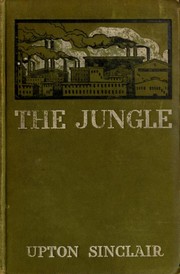
The Jungle
The novel that produced US federal food regulation.
Summary
Sinclair spent seven weeks in the Chicago stockyards in 1904 and wrote a novel about a Lithuanian immigrant family, Jurgis Rudkus and his relatives, who come to Packingtown and are destroyed by it. The family loses money to a fraudulent house purchase, loses members to industrial accidents, disease, prostitution and childbirth, and Jurgis ends the book converted to socialism.
Sinclair's intention was to expose the exploitation of industrial workers: wage theft through the speed-up, the destruction of workers whose bodies were used up, the total absence of compensation for injury, child labour, the corruption of inspectors and police, and the way each family's small savings were extracted by fraud. The passages about contaminated meat, diseased cattle, rats in the sausage and workers falling into rendering tanks occupy a small portion of the book.
Those passages produced the effect. Public outrage about the food supply led directly to the Pure Food and Drug Act and the Federal Meat Inspection Act in 1906, while the labour argument was ignored, which prompted Sinclair's remark that he had aimed at the public's heart and hit its stomach. Historians have questioned some of the specific factual claims, and Sinclair himself acknowledged that parts were composite or exaggerated. As a novel it is didactic and the final chapters are political speech. It is worth reading as the origin of American food regulation, as evidence about industrial working conditions, and as a case in which a campaign produced a real result on a subject other than the one it was arguing.
Key takeaways 7
- Industrial workers in the Chicago packing houses had no compensation for injury, no job security and no recourse against wage theft through work speed-ups.
- The meat packing industry sold diseased and contaminated product because inspection was captured and no mechanism made contamination visible to buyers.
- Immigrant families were systematically stripped of savings through fraudulent property contracts, predatory lending and corrupt intermediaries.
- The reform the book produced concerned food safety rather than labour conditions, because consumers were affected by one and not the other.
- Large packing firms supported federal inspection once it was inevitable, because it imposed costs their smaller competitors could not carry and restored export markets.
- Industrial employment used workers until injury or illness ended their usefulness and then replaced them, because replacement was cheaper than prevention.
- Political outrage attaches to harms that reach the people with political power, not to the greater harms suffered by those without it.
Who should read it
Readers interested in the origin of food and drug regulation and in how a reform campaign produces results on a subject other than its target.
Where it sits in the reference 2
Who recommended it 2 · 1 direct
Similar books 6
Chosen by shared topics, the entries that hold them, and the people who recommended both.