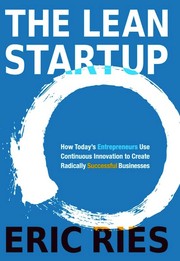
The Lean Startup
Innovation accounting and cohort metrics for a business with no history.
Summary
Ries defines a startup as a human institution designed to deliver a new product or service under conditions of extreme uncertainty, and argues that its central activity is learning what customers want. He proposes validated learning as the unit of progress, measured by experiments rather than by shipped features or business plan milestones.
The method runs on a build-measure-learn loop. A team states its leap-of-faith assumptions about value and growth, builds a minimum viable product to test them, measures with actionable rather than vanity metrics, and then decides to persevere or pivot. Ries defines several types of pivot, including zoom-in, customer segment, platform and business architecture pivots, and argues that the pivot decision should be scheduled rather than left to a crisis. He also introduces innovation accounting, which sets a baseline, tunes the engine, and then evaluates whether the improvements justify continuing.
The book carries a strong operational component drawn from lean manufacturing. Ries argues for small batch sizes, continuous deployment, the andon cord, and five whys root-cause analysis adapted to software teams. His engines of growth framework identifies sticky, viral and paid growth as three distinct models with different governing metrics.
The evidence is anecdotal, drawn mainly from IMVU, where Ries was a founder, plus consulting cases. The IMVU story has been questioned, and the minimum viable product concept has been widely misused to justify shipping poor products. Thiel and others argue that iteration cannot substitute for a strong initial hypothesis, and several large companies succeeded by doing the opposite of what the book recommends. The framework works best where customer demand is genuinely unknown and worst where the technical risk dominates.
Key takeaways 8
- A startup exists to learn what customers want under extreme uncertainty, so validated learning rather than product output measures progress.
- Every business plan contains leap-of-faith assumptions about value and about growth, and those should be tested first and directly.
- A minimum viable product exists to test a hypothesis at the lowest cost, not to ship the smallest version of the intended product.
- Vanity metrics such as cumulative totals conceal performance, and teams should use cohort-based actionable metrics instead.
- A pivot changes strategy without abandoning the accumulated learning, and teams should schedule pivot decisions rather than delay them until a crisis.
- Small batch sizes and continuous deployment reduce the time between an idea and evidence about it.
- Growth runs on one of three engines, sticky, viral or paid, and each has a different governing metric that a team should optimise alone.
- Working harder on a product nobody wants is the most common form of startup waste, and it looks like productivity from inside.
Who should read it
First-time founders and product teams in markets where customer demand is unproven, who need a discipline for testing assumptions before building.
Where it sits in the reference 5
Who recommended it 21 · 2 direct
Similar books 6
Chosen by shared topics, the entries that hold them, and the people who recommended both.