The Goal
Constraint theory taught as a novel; throughput accounting made intuitive.
Summary
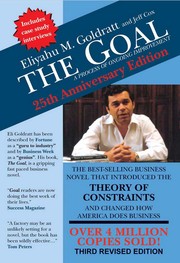
Goldratt presents the theory of constraints as a business novel. Alex Rogo runs a failing manufacturing plant with three months to turn it around, and works out the method with occasional prompting from a physicist named Jonah, who is Goldratt.
The argument starts by rejecting conventional cost accounting measures. Goldratt defines the goal of a company as making money, and states three operational measures: throughput, meaning the rate at which the system generates money through sales; inventory, meaning money tied up in things it intends to sell; and operational expense, meaning money spent turning inventory into throughput. He argues that local efficiency measures, including machine utilisation and cost per unit, actively damage all three by producing work in process that cannot be sold.
The core insight is that a system's output is determined entirely by its constraint, so improvements anywhere else produce nothing. He gives five focusing steps: identify the constraint, decide how to exploit it, subordinate everything else to that decision, raise the constraint's capacity, and then repeat because the constraint will have moved. The scout hike scene, where the slowest boy determines the troop's pace and the gaps in the line represent accumulated inventory, is the clearest demonstration.
The novel form makes the argument accessible and also pads it. The family subplot is thin. The manufacturing setting means the reader must translate for other contexts, though Goldratt and others later applied the method to projects, software and services. The critique of cost accounting is the most contested element and accountants dispute parts of it. The five focusing steps have held up and appear throughout modern operations and software delivery practice.
Key takeaways 8
- The output of any system is determined by its single constraint, so improvements made anywhere else produce no additional throughput.
- A company's goal is making money, and any measure that does not connect to throughput, inventory or operational expense is misleading.
- Local efficiency measures such as machine utilisation cause managers to produce inventory that cannot be sold, which damages the company while improving the metric.
- Idle time at a non-constraint resource is not waste, and keeping every resource busy is the most common and most expensive operational error.
- Statistical fluctuations combined with dependent events mean that a balanced plant with equal capacity everywhere performs worse than one with deliberate excess capacity.
- The constraint should be protected with a buffer and never left idle, because an hour lost at the constraint is an hour lost for the whole system.
- Once a constraint is elevated it moves elsewhere, so the improvement process must repeat rather than terminate.
- Cost accounting conventions that allocate overhead per unit produce decisions that reduce company profit while appearing to reduce cost.
Who should read it
Operators running any process with sequential dependencies, including manufacturing, software delivery and services, who need the constraint framework.
About Eliyahu M. Goldratt
Israeli physicist and management theorist who created the Theory of Constraints and founded the Avraham Y. Goldratt Institute.
The Goal teaches throughput accounting and constraint management inside a plant-turnaround novel: find the bottleneck, subordinate every other decision to it, raise it, then repeat. The method transfers to any process with a limiting step, which is why operations, project and software-delivery teams still run on it.
Where it sits in the reference 7
Who recommended it 7 · 3 direct
Similar books 6
Chosen by shared topics, the entries that hold them, and the people who recommended both.