Theory of Constraints
Summary
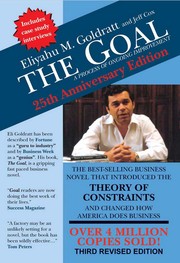
Goldratt sets out the theory of constraints more formally than in The Goal, presenting it as a general method for improving any system rather than as a manufacturing technique.
The central claim is that every system has at most a small number of constraints limiting its output, that improvement anywhere except at the constraint produces no gain in system output, and that most management effort is therefore wasted. The five focusing steps follow: identify the constraint, decide how to exploit it so that no constraint capacity is wasted, subordinate everything else to that decision, raise the constraint by adding capacity, and then return to the first step because the constraint will have moved.
He also sets out his accounting objection. Cost accounting allocates overhead to units produced and therefore rewards local efficiency, which encourages producing inventory that the constraint cannot process. He proposes throughput accounting instead, measuring throughput, meaning the rate at which the system generates money through sales; inventory, meaning money tied up in things the system intends to sell; and operating expense, meaning money spent converting inventory into throughput.
The book also introduces the thinking processes, being a set of logic tools for identifying root causes and constructing solutions, which Goldratt developed further in later work.
The method has been applied successfully in manufacturing and project environments and the evidence is largely practitioner reports. Goldratt's dismissal of cost accounting is stated more absolutely than the case supports. The core insight about constraints is correct, simple and consistently underapplied.
Key takeaways 7
- Every system is limited by a small number of constraints, and improvement anywhere except at the constraint produces no gain in system output.
- The constraint's capacity must never be wasted, which means everything else in the system should be subordinated to keeping it working.
- Once a constraint's capacity is raised the constraint moves elsewhere, so the improvement process must repeat rather than conclude.
- Cost accounting allocates overhead to units produced and therefore rewards local efficiency, which encourages building inventory the constraint cannot process.
- Throughput, inventory and operating expense are the three measures that connect local decisions to whether the system makes money.
- Local optimisation of every function produces a system that performs worse than one where most functions deliberately run below capacity.
- Identifying the constraint is usually easy and is nonetheless skipped, because management attention is allocated by visibility rather than by leverage.
Who should read it
Operators who want the general statement of constraint-based improvement and the accounting argument that supports it.
About Eliyahu M. Goldratt
Israeli physicist and management theorist who created the Theory of Constraints and founded the Avraham Y. Goldratt Institute.
The Goal teaches throughput accounting and constraint management inside a plant-turnaround novel: find the bottleneck, subordinate every other decision to it, raise it, then repeat. The method transfers to any process with a limiting step, which is why operations, project and software-delivery teams still run on it.
Where it sits in the reference 4
Similar books 6
Chosen by shared topics, the entries that hold them, and the people who recommended both.