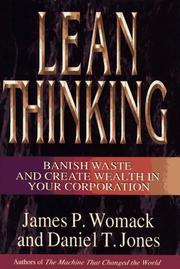
Lean Thinking
Value, flow and pull generalised beyond the car industry.
Summary
Womack and Jones generalise the Toyota Production System into five principles applicable beyond automotive manufacturing, following their earlier study The Machine That Changed the World.
The five principles are: specify value from the end customer's perspective, since value defined by the producer is usually the producer's convenience; identify the value stream, meaning every step from raw material to customer, and classify each step as creating value, creating no value but currently unavoidable, or creating no value and immediately removable; make value flow continuously by eliminating the batching, queuing and departmental handoffs that create waiting; let the customer pull value rather than producing to a forecast and pushing inventory downstream; and pursue perfection through repeated cycles, since each improvement reveals the next constraint.
Their empirical claim is that mapping a complete value stream in most organisations reveals that the large majority of elapsed time adds no value, with the actual work occupying a small fraction of the total. The case studies cover manufacturers in several countries including Pratt and Whitney, Porsche, Lantech and Wiremold, with before and after figures for inventory, lead time, space and productivity. The book also covers the organisational difficulty, including that value streams cross departmental boundaries and that departmental optimisation is what produces the waste.
The examples are manufacturing and the translation to service and knowledge work, which the authors attempted later, is harder than they present it. Lean has been widely implemented as a cost-cutting programme rather than as the system described, which the authors have criticised. The value stream mapping method is the tool practitioners use.
Key takeaways 8
- Value must be specified from the end customer's perspective, since value defined by the producer usually describes the producer's convenience.
- Mapping a complete value stream reveals that the large majority of elapsed time adds no value, with actual work occupying a small fraction.
- Every step in a process should be classified as creating value, creating none but currently unavoidable, or creating none and immediately removable.
- Batching, queuing and departmental handoffs create the waiting that constitutes most of the elapsed time.
- Production should be pulled by actual customer demand rather than pushed from a forecast, which removes the inventory that conceals problems.
- Value streams cross departmental boundaries, and optimising each department separately is what produces the waste.
- Each improvement reveals the next constraint, which means the process repeats rather than completing.
- Lean has been widely implemented as a cost-cutting programme rather than as the system described, which the authors have criticised.
Who should read it
Operators in manufacturing and in any process business who want the value stream mapping method and the five principles in their original form.
Where it sits in the reference 3
Who recommended it 2 · 1 direct
Similar books 6
Chosen by shared topics, the entries that hold them, and the people who recommended both.