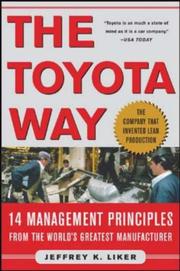
The Toyota Way
The most widely used codification of Toyota's management principles.
Summary
Liker, an engineering professor who studied Toyota for two decades, sets out the company's management system as fourteen principles grouped into four categories: long-term philosophy, the right process producing the right results, developing people and partners, and continuously solving root problems to drive learning.
The process principles restate and extend the production system: create continuous flow to bring problems to the surface, use pull systems to avoid overproduction, level the workload rather than responding to demand variation directly, build a culture of stopping to fix problems, standardise tasks as the foundation for improvement, use visual control so no problem is hidden, and use only reliable thoroughly tested technology.
The distinctive material relative to Ohno's own book is the emphasis on people and on the philosophical layer. Liker argues that leaders must be grown from within because the system depends on knowledge that cannot be transferred quickly, that suppliers should be challenged and helped to improve rather than squeezed on price, that decisions should be made slowly by consensus considering all options and implemented rapidly, and that management must go and see the actual situation directly rather than working from reports.
His argument about why copying Toyota fails is the most useful part: companies adopt the visible tools without the underlying philosophy, the long-horizon commitment and the people development, and the tools then produce nothing.
The book is long and repetitive and the case examples are from the period before Toyota's 2009 and 2010 recall crisis, which complicated the account of the company's quality system.
Key takeaways 7
- Levelling workload so that production runs at a steady rate is a precondition for the rest of the system, because variation makes standardisation impossible.
- Continuous flow forces problems to the surface immediately, which is the point of it rather than a side effect.
- Standardised work is the foundation for improvement rather than a constraint on it, since a process that varies cannot be improved measurably.
- Managers must observe the actual situation directly rather than working from reports, because the information that matters does not survive summarisation.
- Decisions should be made slowly by consensus considering all alternatives and then implemented rapidly, which is the reverse of the usual pattern.
- Suppliers should be challenged and helped to improve rather than squeezed on price, since their capability determines what the manufacturer can build.
- Companies fail to copy Toyota because they adopt the visible tools without the long-horizon commitment and people development that make the tools function.
Who should read it
Operators attempting to implement lean or continuous improvement who need the philosophical and people components alongside the tools.
Where it sits in the reference 4
Similar books 6
Chosen by shared topics, the entries that hold them, and the people who recommended both.