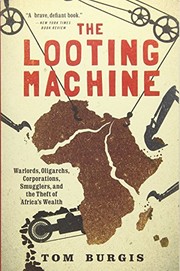
The Looting Machine
How resource rents are extracted across Africa, with Nigeria at the centre.
Summary
Burgis, a Financial Times investigations reporter who covered Africa, examines how resource wealth is extracted from African countries in ways that leave the population poorer.
His analytical concept is the shadow state. Behind the formal government sits a network of officials, intermediaries and foreign companies that controls the resource revenue, and this network is where decisions are actually made. Formal institutions continue to exist and to hold elections while the resource rent flows through the shadow structure. Burgis argues this is not a failure of governance but a stable arrangement that serves the participants.
The reporting covers specific cases. In Angola he traces the role of Sonangol and the network around the presidency. In the Democratic Republic of Congo he documents mining assets sold below value to offshore companies and resold at large profits, with the difference lost to the state, drawing on the work that also informed the Africa Progress Panel's findings. In Nigeria he covers oil theft, subsidy fraud and the Malabu oil block. In Guinea and Zimbabwe he covers mining concessions.
A recurring subject is the Queensway Group, a Hong Kong-based network associated with Sam Pa, which arranged infrastructure-for-resources deals across several African states, and whose ownership and control Burgis attempts to establish.
His argument connects these to the resource curse literature: resource rents fund the state without taxation, which removes the accountability that taxation creates, and the extraction requires very few workers, which severs the connection between national income and employment.
The book is investigative journalism, so it establishes specific transactions rather than testing the general claim statistically. Some subjects disputed the reporting. The mechanism it documents, in which state assets are sold to offshore vehicles at a fraction of value, is well evidenced.
Key takeaways 7
- Resource rents fund states without taxation, which removes the accountability that taxing citizens creates.
- Resource extraction employs very few people, so national income rises without any connection to employment or wages.
- State mining and oil assets have been sold to offshore vehicles at fractions of their value and resold immediately at large profits.
- A shadow network of officials, intermediaries and foreign firms controls resource revenue while formal institutions continue to operate.
- Infrastructure-for-resources deals transfer long-term resource rights against construction whose value is difficult to verify.
- Offshore corporate secrecy is the enabling mechanism, because it prevents anyone establishing who benefits from a transaction.
- The arrangement is stable rather than dysfunctional, because it serves every participant with the power to change it.
Who should read it
Investors and operators in African resource markets who need to understand the transaction structures and political networks that determine who captures value.
Where it sits in the reference 3
Similar books 6
Chosen by shared topics, the entries that hold them, and the people who recommended both.