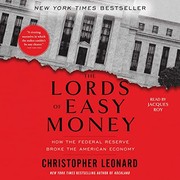
The Lords of Easy Money: How the Federal Reserve Broke the American Economy
Quantitative easing told through Thomas Hoenig's dissents.
Summary
Leonard tells the story of Federal Reserve policy from 2010 through 2021 largely through Thomas Hoenig, the Kansas City Fed president who dissented at every Federal Open Market Committee meeting in 2010 against quantitative easing and zero rates. The reporting draws on FOMC transcripts, which are released after five years, and on interviews.
The argument is that quantitative easing worked mainly by raising asset prices and pushing investors into riskier assets, and that this had distributional and structural consequences the Fed did not intend and does not measure. Leonard follows the money into corporate debt, leveraged loans and collateralised loan obligations, into private equity dividend recapitalisations, and into share buybacks. He argues that cheap debt let weak companies survive, encouraged financial engineering over investment, and concentrated gains among people who already owned assets. He uses Rexnord, an industrial company loaded with debt through successive buyouts, as an extended case.
The book ends with the 2020 response, which Leonard reads as the same policy at far greater scale, and treats the subsequent inflation as partial vindication of Hoenig.
Mainstream economists dispute the central causal claims. Most evidence indicates that quantitative easing had modest effects on output and that the alternative, tighter policy in 2010, would have produced higher unemployment. Hoenig's specific warning was about inflation, which did not appear for a decade, and the 2021 inflation is generally attributed to fiscal transfers and supply shocks rather than to asset purchases. Leonard also does not seriously engage the counterfactual.
Key takeaways 7
- Quantitative easing transmits primarily through asset prices, so its first-order effect is to enrich people who already hold assets.
- Prolonged low rates pushed institutional investors into corporate credit and leveraged loans in search of yield.
- Cheap debt allowed companies to fund buybacks and dividend recapitalisations instead of capital investment.
- The Federal Reserve has no mandate covering asset price inflation or wealth distribution, so it does not measure the effects it produces.
- Thomas Hoenig's 2010 dissents argued that the policy would misallocate capital rather than that it would fail to stimulate.
- The 2020 intervention extended Federal Reserve support to corporate bonds and set a precedent for backstopping private credit.
- Financial engineering at companies like Rexnord transferred value to owners while increasing the fragility of the operating business.
Who should read it
Investors and operators who want the case that a decade of monetary policy reshaped credit markets and corporate behaviour, read alongside a mainstream defence of the same policy.
Where it sits in the reference 2
Who recommended it 1
Similar books 6
Chosen by shared topics, the entries that hold them, and the people who recommended both.