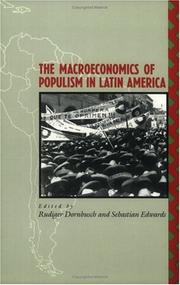
The Macroeconomics of Populism in Latin America
The four-phase populist cycle; still the best predictive framework for the region.
Summary
Rudiger Dornbusch and Sebastian Edwards edited this volume, and their own introductory essay defining macroeconomic populism has been more influential than any of the case studies.
Their definition is specific and not about political style. Macroeconomic populism is an approach that emphasises growth and income redistribution while deemphasising the risks of inflation, deficit finance, external constraints and the reaction of economic agents to aggressive non-market policies. They set out a four-phase cycle. In the first, the programme works: output and real wages rise, and the initial results appear to vindicate the critics of orthodox policy. In the second, bottlenecks appear, inventories are exhausted, imports rise and the current account deteriorates while price controls suppress the signals. In the third, shortages, inflation acceleration and capital flight force devaluation and fiscal correction; real wages collapse. In the fourth, a new orthodox government stabilises, typically under International Monetary Fund supervision, and real wages end below where they began.
The case studies apply this to Chile under Allende, Peru under Garcia, Argentina under multiple governments, Brazil, Mexico and Nicaragua. The framework has been criticised for lumping distinct political programmes together, for treating the outcomes as inevitable rather than as consequences of specific choices, and for its use to discredit redistribution generally. It has also been applied successfully to subsequent episodes including Venezuela. The introductory essay is the essential reading.
Key takeaways 7
- Macroeconomic populism emphasises growth and redistribution while dismissing inflation, deficits and external constraints as secondary.
- The programme's first phase works, which is what makes the approach politically attractive and analytically dangerous.
- Bottlenecks and current account deterioration appear in the second phase while price controls suppress the signals that would reveal them.
- The third phase brings shortages, capital flight, forced devaluation and a collapse in real wages.
- Workers end the cycle with real wages below where they started, which is the outcome the programme was designed to prevent.
- The authors argue that the cycle recurs because each generation of policymakers treats the previous failure as a special case.
- Critics argue the framework lumps distinct political programmes together and treats specific policy choices as inevitable.
Who should read it
Investors in emerging markets who want the analytical template for recognising a policy programme that will end in currency and inflation crisis.
Where it sits in the reference 2
Similar books 6
Chosen by shared topics, the entries that hold them, and the people who recommended both.