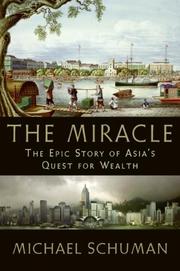
The Miracle
Asia's growth stories told through the people who drove them.
Summary
Schuman, a Time and Wall Street Journal correspondent in Asia, wrote a narrative history of East Asian economic growth from the 1950s to the 2000s, organised around individuals rather than around models. Chapters follow figures including Park Chung-hee and the Korean chaebol founders, Japanese planners and industrialists, Lee Kuan Yew and Goh Keng Swee in Singapore, K T Li in Taiwan, Deng Xiaoping's reformers, and Indian liberalisers including Manmohan Singh.
His interpretation sits between the two standard positions. He accepts that governments in Korea, Taiwan, Japan and Singapore intervened heavily through credit allocation, protection and export targets, and he does not pretend the growth was laissez-faire. He also argues that the decisive common factor was the discipline of export markets, which forced firms to become internationally competitive and gave governments an objective test of whether their picks were working. He treats Southeast Asian crony capitalism and the 1997 crisis as evidence of what happens when the export test is replaced by political allocation without accountability.
The method is journalism and interview rather than economic analysis, so there is no data work and no engagement with the econometric debates. Readers who want the state-led case in rigorous form should go to Amsden or Wade, and the market-oriented case to the World Bank's East Asian Miracle report.
The book stops before China's post-2008 credit expansion and before the growth slowdowns across the region, which changes how some of the concluding optimism reads.
Key takeaways 7
- East Asian growth was directed by governments that allocated credit and protected industries, not by free markets.
- Export competition supplied the discipline that made industrial policy work, by giving governments a hard test of firm performance.
- Korea's chaebol grew because the state tied subsidised credit to export performance and withdrew support from failures.
- Singapore's growth strategy depended on attracting foreign multinationals, which contradicts the Korean and Japanese model.
- The 1997 Asian crisis followed from allocating capital politically without the export discipline that had constrained earlier policy.
- India's post-1991 growth came from removing licensing restrictions rather than from adopting an East Asian industrial policy.
- Individual officials with authority over credit and licensing shaped national outcomes more than institutions did.
Who should read it
Investors and operators working in Asian markets who want an accessible narrative of how these economies were built, before turning to the technical literature.
Where it sits in the reference 2
Who recommended it 1 · 1 direct
Similar books 6
Chosen by shared topics, the entries that hold them, and the people who recommended both.