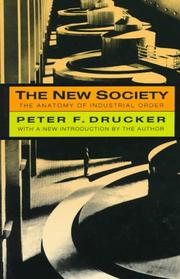
The New Society
Summary
Peter Drucker published this in 1949 as the third of his early books on industrial society, following The End of Economic Man and The Future of Industrial Man. It is a social and political analysis rather than a management text, and it precedes The Practice of Management by five years.
His subject is the industrial enterprise as the constitutive institution of modern society. Drucker argues that the large corporation, not the state or the market, is where most people in industrial societies experience social organisation, and that its legitimacy therefore becomes a political question. He examines the plant community, meaning the social structure of the workplace, and argues that workers need status and function within it, which the industrial system as then organised did not supply.
The book covers the conflicts he sees as structural: between the enterprise's need for profit and the worker's need for security, between managerial authority and its legitimation, and between union and management claims to represent the worker. He argues for what he calls the self-governing plant community, in which workers take responsibility for aspects of their own work organisation, an idea that anticipates much later thinking about participation and that was not adopted. The book is dated in its specific industrial context and its assumptions about mass production employment. Its framing question, of how large organisations acquire legitimacy over the people inside them, remains open.
Key takeaways 7
- The large corporation, not the state or the market, is where most people in industrial societies experience social organisation.
- Managerial authority requires legitimation, and the industrial system as organised in 1949 supplied none.
- Workers need status and function within the plant community, which wages alone do not provide.
- Drucker proposes a self-governing plant community in which workers take responsibility for their own work organisation.
- The conflict between the enterprise's need for profit and the worker's need for security is structural rather than a management failure.
- Union and management both claim to represent the worker, which makes the claim itself a source of conflict.
- Drucker treats the legitimacy of large organisations over the people inside them as the central political question of industrial society.
Who should read it
Readers of Drucker who want his social and political analysis of the corporation, written before he turned to management as a discipline.
About Peter F. Drucker
Management writer and consultant; professor at Bennington, NYU and Claremont Graduate University
He invented management as a field of study, and The Practice of Management and The Effective Executive remain the primary sources every later writer builds on.
Where it sits in the reference 2
Similar books 6
Chosen by shared topics, the entries that hold them, and the people who recommended both.