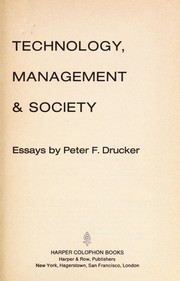
Technology, Management and Society
Summary
This collects essays Drucker wrote through the 1950s and 1960s on technology, its history, and its relationship to management and to social organisation.
The historical essays argue that technology should be understood as a social phenomenon rather than as a sequence of inventions. His piece on the first technological revolution argues that irrigation civilisation, not the industrial revolution, was the transformation that created the institutions of organised human society: permanent settlement, specialised labour, government, taxation, standing armies, writing and law all follow from the requirement to manage water at scale. His treatment of the industrial revolution argues its distinguishing feature was the systematic application of knowledge to work rather than the machines themselves.
The management essays cover long-range planning, which he argues is not about predicting the future but about deciding what to do now in view of an unpredictable one, and the specific claim that the important question is not what will happen but what has already happened that will have consequences. His concept of the futurity of present decisions, meaning that every decision commits resources to a future whose conditions are unknown, is stated here.
He also covers automation, which he argued would not produce mass unemployment but would change the composition of work toward knowledge, and the social responsibilities of the corporation.
The collection is from 1970 and the specific technological subjects are dated. The historical arguments about technology as social organisation and the treatment of planning under uncertainty are the durable contributions.
Key takeaways 7
- Irrigation civilisation rather than the industrial revolution was the technological transformation that created government, taxation, writing, law and specialised labour.
- The industrial revolution's distinguishing feature was the systematic application of knowledge to work rather than the machinery itself.
- Long-range planning is not prediction but deciding what to do now in view of a future that cannot be predicted.
- The useful question is not what will happen but what has already happened that will have consequences nobody has yet acted on.
- Every decision commits resources to a future whose conditions are unknown, which is the irreducible risk in any plan.
- Automation changes the composition of work toward knowledge rather than producing mass unemployment.
- Technology should be analysed as a form of social organisation rather than as a sequence of inventions.
Who should read it
Readers interested in Drucker's historical treatment of technology as social organisation and his account of planning under uncertainty.
About Peter F. Drucker
Management writer and consultant; professor at Bennington, NYU and Claremont Graduate University
He invented management as a field of study, and The Practice of Management and The Effective Executive remain the primary sources every later writer builds on.
Where it sits in the reference 2
Who recommended it 1 · 1 direct
Similar books 6
Chosen by shared topics, the entries that hold them, and the people who recommended both.