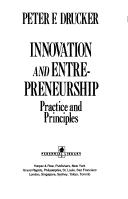
Innovation and Entrepreneurship
Includes Drucker's typology of pricing and delivery strategies.
Summary
Drucker argues that innovation is a discipline that can be learned and practised systematically rather than a matter of inspiration or personality, and that entrepreneurship is a specific management behaviour available to existing institutions as well as to new ventures.
His central contribution is the seven sources of innovative opportunity, ordered by reliability. The first four are internal to an industry or institution: the unexpected, meaning unexpected success, failure or outside event; the incongruity between what is and what everyone assumes; process need, where a step in an existing process is known to be weak; and changes in industry or market structure. The last three are external: demographics, which he calls the most reliable because the data exists and the timing is knowable; changes in perception, meaning a shift in how people understand a situation without any change in the facts; and new knowledge, which he ranks last because the lead times are longest and the failure rate highest despite its prestige.
He gives principles for practice, including that innovation should be simple and focused on one thing, should start small, and should aim at leadership in a defined market. The entrepreneurial strategies section covers being first with the most, creative imitation, entrepreneurial judo which attacks incumbents where their assumptions leave them exposed, ecological niches including toll gate positions, and changing the economic characteristics of an existing product.
The examples date from before 1985. The claim that new knowledge is the least reliable source will strike technology readers as wrong, though Drucker's point about lead times and failure rates is defensible. The seven sources remain the most systematic checklist available for finding opportunity.
Key takeaways 8
- Innovation is a discipline that can be practised systematically rather than a matter of inspiration or personality.
- There are seven sources of innovative opportunity, and they differ substantially in reliability and in the lead time required.
- Unexpected success is the most neglected source, because organisations investigate failures and dismiss successes they did not plan.
- Demographic change is the most reliable source because the data exists and the timing is knowable years in advance.
- Innovation based on new knowledge has the longest lead times and the highest failure rate despite carrying the most prestige.
- An innovation should do one thing, should be simple enough to explain, and should start small enough to be corrected.
- Entrepreneurial judo attacks incumbents where their assumptions leave them exposed rather than where they are strong.
- Changing the economic characteristics of an existing product, including how it is priced or delivered, is an innovation without any technical change.
Who should read it
Founders and executives looking systematically for opportunity who want a checklist of where innovations actually come from.
About Peter F. Drucker
Management writer and consultant; professor at Bennington, NYU and Claremont Graduate University
He invented management as a field of study, and The Practice of Management and The Effective Executive remain the primary sources every later writer builds on.
Where it sits in the reference 3
Who recommended it 3 · 1 direct
Similar books 6
Chosen by shared topics, the entries that hold them, and the people who recommended both.