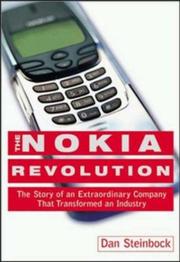
The Nokia Revolution
Written at the peak, before the decline; Open Library unreachable this pass.
Summary
The reference has not verified this book in detail; the summary states only what the title, author and subject establish.
Dan Steinbock wrote this account of Nokia's transformation from a Finnish conglomerate with rubber, cable and forestry businesses into the dominant global mobile phone maker.
The history covers the company's origins, the diversification of the 1970s and 1980s, the crisis of the early 1990s that included the suicide of its chief executive and the collapse of Soviet trade, and the decision under Jorma Ollila to divest everything except telecommunications. It covers the Nordic mobile standard that gave Finnish and Swedish firms an early lead, the GSM standard and Nokia's position in it, the design and brand work that turned handsets into consumer products, and the manufacturing and logistics operation that supported enormous volumes.
The reference has not verified this book in detail. It was published in 2001, at the top of Nokia's position and before the events that destroyed it, and its account of the company's advantages is written without knowledge of how quickly they eroded. Readers wanting the fall should go to David Cord's account. Its value is the pre-decline history of how the position was built.
Key takeaways 6
- Nokia divested rubber, cable and forestry businesses to concentrate entirely on telecommunications, which was the decision that created the company.
- The Nordic mobile telephone standard gave Finnish and Swedish firms an early lead in cellular technology.
- Nokia treated handsets as consumer products with design and brand attributes rather than as telecommunications equipment.
- The collapse of Soviet trade and the Finnish banking crisis of the early 1990s forced the strategic concentration.
- Manufacturing and logistics capability supporting enormous volumes was a competitive advantage in its own right.
- The book was published at the top of Nokia's position and does not anticipate how quickly its advantages eroded.
Who should read it
Readers wanting the history of how Nokia's position was built, with the caveat that this entry is not verified in detail and the book predates the decline.
Where it sits in the reference 2
Similar books 6
Chosen by shared topics, the entries that hold them, and the people who recommended both.