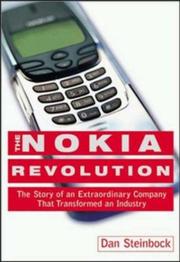
Winning Across Global Markets
Nokia's emerging-market operating model at the turn; Open Library unreachable.
Summary
The reference has not verified this book in detail; the summary states only what the title, author and subject establish.
Steinbock, a researcher on technology and globalisation, wrote about Nokia's international expansion and what he presents as a transferable model of global market development. The reference has not verified the book's detailed contents.
The subject is the company's rise from a Finnish conglomerate with roots in paper and rubber to the world's dominant mobile handset maker. The established elements of that history include the decision in the early 1990s to divest the non-telecommunications businesses and concentrate on mobile; the advantage of coming from a small home market, which forced international orientation from the start; the Nordic NMT standard and later the European GSM standard, which gave European manufacturers scale before American competitors; the early recognition that handsets would become consumer products requiring segmentation, design and brand rather than engineering alone; and the distribution and manufacturing scale that produced cost leadership across price points including entry-level phones for emerging markets.
The book was published in 2010, at the point where Nokia's position was already deteriorating. The company retained volume leadership while losing the smartphone segment to Apple and Android, and its market position collapsed over the following three years. The strategic framework the book presents therefore describes a company at the end of its success rather than during it, which readers should hold in mind. Anyone wanting the account of the decline should look at the substantial subsequent literature on it.
Key takeaways 6
- A small home market forces international orientation from the start, which was a structural advantage rather than a limitation.
- European GSM standardisation gave European manufacturers scale advantages that fragmented American standards prevented.
- Nokia treated handsets as consumer products requiring segmentation, design and brand rather than as engineering devices.
- Manufacturing and distribution scale across price points produced cost leadership including in entry-level emerging market phones.
- Divesting unrelated businesses to concentrate on mobile was the decision that made the company's later position possible.
- The framework describes the company at the point its position was already being lost, so its predictive value is limited.
Who should read it
Readers researching Nokia's international expansion specifically, who should pair it with an account of the collapse that followed publication.
Where it sits in the reference 3
Similar books 6
Chosen by shared topics, the entries that hold them, and the people who recommended both.