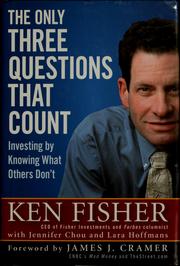
The Only Three Questions That Count: Investing by Knowing What Others Don't
Reissued 2012 as The Only Three Questions That Still Count.
Summary
Ken Fisher argues that outperforming the market requires knowing something the market does not, and that there are only three questions capable of generating such knowledge. The book is structured around them.
The first question is what do you believe that is actually false. Fisher argues that most widely held investment beliefs are empirically wrong and that testing them against data is the most productive research activity available. He works through examples: that high price-earnings ratios predict poor returns, that budget deficits are bad for stocks, that a strong dollar helps American equities, that high dividend yields provide safety.
The second question is what can you fathom that others find unfathomable. This concerns finding relationships that others have not looked for, and Fisher gives methods including examining data others dismiss, thinking about supply of securities rather than only demand, and taking a global rather than a national view when everyone else is domestic. The third question is what is my brain doing to mislead me now, which covers the behavioural material, particularly Fisher's argument that the mind accumulates pride for successes and shunts blame for failures, which prevents learning.
The book is longer than it needs to be and Fisher is selling an advisory service. The first question is the most useful contribution: the discipline of testing a belief against data before acting on it is the correct research method and almost nobody applies it systematically.
Key takeaways 7
- Outperformance requires knowing something the market does not, so research should target widely held beliefs that data contradicts.
- Most widely held investment beliefs, including that high valuations predict poor near-term returns, fail when tested against history.
- Securities supply, meaning issuance and buybacks, affects prices as much as demand does and is almost never analysed.
- A global rather than a national perspective supplies information to investors whose competitors look only at their own market.
- Fisher argues that the mind accumulates pride for successes and assigns blame for failures elsewhere, which prevents learning from either.
- Testing a belief against data before acting on it is the correct research method and is almost never applied systematically.
- Fisher has a commercial interest in the advisory service the book implicitly promotes.
Who should read it
Investors who want a research method for generating differentiated views rather than a set of conclusions to adopt.
About Ken Fisher
Founder and Executive Chairman, Fisher Investments; Forbes "Portfolio Strategy" columnist 1984-2016
A long, public money-management record plus Super Stocks, which introduced the price-to-sales ratio and outlived its news cycle.
Where it sits in the reference 2
Similar books 6
Chosen by shared topics, the entries that hold them, and the people who recommended both.