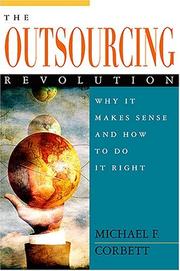
The Outsourcing Revolution
Practitioner survey of outsourcing decisions and their economics.
Summary
The reference has not verified this book in detail; the summary states only what the title, author and subject establish.
Michael Corbett founded an outsourcing professionals association and wrote this as a practitioner guide to outsourcing decisions, at a point when business process and information technology outsourcing were growing rapidly.
The content covers the decision framework: which activities to outsource and which to retain, the argument that a firm should keep the activities in which it can be distinctive and contract for the rest; the evaluation of providers; the structuring of contracts including service level agreements, pricing models and governance provisions; the transition and its risks; the management of the ongoing relationship; and the measurement of results. He also covers offshore delivery and the labour and political questions attached to it.
The reference has not verified this book in detail, and this entry describes the standard content of the field rather than the author's specific arguments. Readers should note that the book dates from 2004, before the maturation of offshore delivery, before the shift toward cloud services that replaced much information technology outsourcing, and before the reshoring and automation developments that changed the economics again. Williamson's transaction cost framework supplies the theoretical basis for these decisions and is more durable.
Key takeaways 6
- A firm should retain activities where it can be distinctive and contract for those where it cannot.
- Outsourcing contracts fail through inadequate specification of service levels and through governance provisions that nobody exercises.
- Transition is the period of highest risk, because knowledge held by departing staff is lost before the provider has acquired it.
- Pricing models allocate risk between client and provider, and a fixed price transfers demand uncertainty to the provider at a cost.
- The ongoing relationship requires client-side management capability that outsourcing was often intended to eliminate.
- Williamson's transaction cost framework supplies the theoretical basis for these decisions more durably than any practitioner guide.
Who should read it
Executives making outsourcing decisions who want a practitioner framework, with the caveat that this entry is not verified in detail and the market has changed.
Where it sits in the reference 2
Similar books 6
Chosen by shared topics, the entries that hold them, and the people who recommended both.