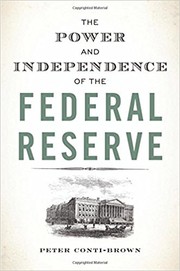
The Power and Independence of the Federal Reserve
What Fed independence legally is, versus what people assume.
Summary
Peter Conti-Brown, a legal scholar, argues that central bank independence is not a single property that an institution either has or lacks, and that treating it as one has prevented clear thinking about the Federal Reserve.
His historical and legal analysis shows how the institution's actual structure developed. The 1913 Act created a decentralised system whose power was distributed between Washington and the reserve banks; the 1935 reforms concentrated it in the Board of Governors; the 1951 Accord with the Treasury established the Federal Reserve's authority over monetary policy after wartime rate pegging; and the practice since has been shaped as much by personalities and by relationships as by statute. He shows that the fourteen-year governor terms, cited as a guarantee of independence, are rarely served in full, so that presidents appoint governors far more frequently than the statute implies.
His analytical contribution is to break independence into components: independence from whom, over what, and through what mechanism. He examines the personnel dimension, the budgetary independence that comes from the Federal Reserve funding itself from its own operations, the legal ambiguity of the reserve banks' private ownership, and the accountability mechanisms that exist. He is critical of the reserve bank structure and of the role of member banks in selecting their directors. The book is legal and institutional rather than economic and is the best available analysis of what the Federal Reserve actually is as an institution.
Key takeaways 7
- Central bank independence is not a single property but a set of separate relationships, each of which must be specified.
- Fourteen-year governor terms are rarely served in full, so presidents appoint governors far more frequently than the statute suggests.
- The Federal Reserve funds itself from its own operations, which gives it budgetary independence that most agencies lack.
- The 1951 Accord with the Treasury, not the founding statute, established the Federal Reserve's authority over monetary policy.
- Reserve banks are formally private institutions whose directors are selected partly by the banks they supervise.
- Conti-Brown argues that personalities and relationships have shaped the institution's actual independence more than statutory provisions have.
- Accountability and independence are not opposites, and the useful question is which mechanisms hold the institution to account for what.
Who should read it
Investors and policy readers who want a rigorous legal and institutional account of what the Federal Reserve is and where its independence actually comes from.
Where it sits in the reference 2
Similar books 6
Chosen by shared topics, the entries that hold them, and the people who recommended both.