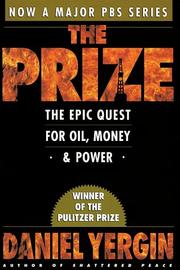
The Prize: The Epic Quest for Oil, Money, and Power
The standard history of the oil industry Exxon inherited and led.
Summary
Yergin writes the history of the oil industry from Drake's 1859 well in Pennsylvania to the Gulf War, connecting the commercial history to geopolitics throughout. The book won the Pulitzer Prize and runs about nine hundred pages.
The commercial history covers Standard Oil's rise and dissolution, the emergence of the Anglo-Persian, Royal Dutch Shell and the international majors, the Achnacarry agreement of 1928 in which the majors divided world markets, the Texas Railroad Commission's control of American production which functioned as a price-setting mechanism for decades, the concession system in the Middle East and the terms that eventually produced nationalisation, the formation of OPEC in 1960, the 1973 embargo, the 1979 shock, and the 1986 price collapse.
The geopolitical argument is the book's contribution. Yergin shows that oil determined military outcomes repeatedly, including the German failure to reach Baku and the Japanese decision for war following the American embargo in 1941, and that oil access shaped the postwar settlement in the Middle East, the Iranian coup of 1953 and the Suez crisis.
The book stops in 1990, so it misses the growth of Chinese demand, the shale revolution which reversed American import dependence, deepwater production and the energy transition. Yergin wrote The Quest as a sequel. Some critics find him too sympathetic to the industry and to the majors' framing of events. The narrative is compelling and dense with detail, and it remains the standard single-volume history of the industry that most shaped the twentieth century.
Key takeaways 8
- Control of oil supply determined military outcomes in both world wars, and the Japanese decision for war followed directly from the American embargo of 1941.
- The industry has repeatedly organised itself to control production and prices, from Standard Oil through the Achnacarry agreement to the Texas Railroad Commission and OPEC.
- Oil price stability has required a swing producer willing to adjust output, and the identity of that producer moved from Texas to Saudi Arabia.
- The concession terms granted to foreign companies in producing countries were unsustainable politically and produced nationalisation once the states had capacity.
- Every period of high prices has produced investment in supply and in substitution that ended it, and every period of low prices has produced the underinvestment that starts the next cycle.
- Foreign policy in the Middle East has been shaped by oil access for a century, including the 1953 Iranian coup and the Suez crisis.
- Vertical integration from wellhead to retail was the industry's defining structure because it protected against the price volatility inherent in the commodity.
- The book ends in 1990 and does not cover shale, Chinese demand growth or the energy transition, which have altered the market it describes.
Who should read it
Investors and executives in energy or commodities who want the full historical context, and readers wanting a demonstration of how a resource shapes geopolitics.
About Daniel Yergin
Vice chairman of S&P Global and co-founder of Cambridge Energy Research Associates; won a Pulitzer Prize for The Prize.
The Prize narrates the oil industry from the first Pennsylvania wells to the Gulf War, establishing how companies, states and cartels have set prices and controlled reserves - the standard reference for anyone underwriting an energy asset. The Quest and The New Map carry that account into shale, renewables and the geopolitics of the energy transition.
Where it sits in the reference 7
Who recommended it 5 · 2 direct
Similar books 6
Chosen by shared topics, the entries that hold them, and the people who recommended both.