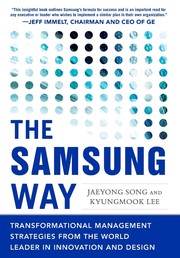
The Samsung Way
Insider-access management study of Lee Kun-hee's reforms; Open Library unreachable.
Summary
Jaeyong Song and Kyungmook Lee, both professors at Seoul National University, had extensive access to Samsung and wrote this academic analysis of the management system behind the company's transformation after 1993.
Their organising concept is what they call paradox management: Samsung's system combines elements that management theory treats as incompatible. It achieves the scale economies of a large diversified conglomerate together with the speed of a smaller firm. It combines Japanese-style long-term orientation and manufacturing discipline with American-style performance-based compensation and external hiring. It maintains centralised control through the owner family and the corporate strategy office while granting operating autonomy to business units. It pursues both cost leadership and differentiation in the same products.
The authors document the mechanisms: the recruitment and development of core personnel, the regional specialist programme sending employees abroad for a year without duties other than learning a country, the compensation system with large performance bonuses, the design investment made from the 1990s, the speed of decision-making enabled by owner authority, and the vertical integration across components and finished goods. They also cover Lee Kun-hee's 1993 Frankfurt declaration and the cultural change it initiated. The book is admiring and was written with company cooperation, which readers should weigh. Its account of the specific management mechanisms is more detailed than any journalistic treatment.
Key takeaways 7
- Samsung's system combines large-firm scale economies with the decision speed usually available only to smaller companies.
- Owner authority permits investment decisions of a size and speed that a professionally managed public company could not make.
- The regional specialist programme sent employees abroad for a year with no duties other than learning a country and its market.
- Compensation combines Japanese-style long-term employment with American-style performance bonuses that vary enormously by unit result.
- Vertical integration across components and finished products supplies cost information and supply security competitors lack.
- Design investment beginning in the 1990s converted Samsung from a component supplier into a consumer brand.
- The book was written with company cooperation and is admiring, which readers should weigh against its conclusions.
Who should read it
Executives and investors who want the detailed management mechanisms behind Samsung's transformation, from academics with company access.
Where it sits in the reference 2
Similar books 6
Chosen by shared topics, the entries that hold them, and the people who recommended both.