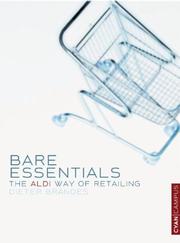
Bare Essentials
A former Aldi director on radical simplicity as the cost model.
Summary
Brandes worked as a senior executive at Aldi under Theo Albrecht and later wrote about the company's method. The book sets out the operating principles of hard discount retailing as Aldi practised them, and argues that simplicity is a deliberate strategy rather than a consequence of low ambition.
The operating model has a small number of connected decisions. Aldi carried roughly six hundred to a thousand items where a supermarket carried tens of thousands. Almost all were private label. The narrow range produced enormous volume per item, which gave Aldi purchasing power that its total revenue alone would not have supported, and let suppliers run long production runs at low cost. Stores were small, fitted cheaply, and stocked from pallets and cases rather than by shelf-filling. Aldi did not advertise beyond price lists, did not run promotions, did not accept manufacturer slotting payments, and did not operate a loyalty programme. It gathered almost no data because the range was too narrow to need category management. Staff numbers per store were very low and pay was above the sector average.
Brandes argues that the principle underneath these choices is the deliberate refusal of complexity, and that most retail cost is generated by variety rather than by volume. He also argues that Aldi's secrecy and family ownership were conditions of the strategy, because a public company would have been pressed to add range and margin.
The book is written by a former insider and reads as advocacy. It offers little analysis of where the model fails, and hard discount has struggled in some markets and product categories. It also predates Aldi and Lidl's expansion into fresh produce, larger ranges and the United States, which complicates the claim that the narrow range is essential.
Key takeaways 7
- Most retail operating cost is generated by the number of items carried rather than by sales volume.
- A range of under a thousand items produces enough volume per item to give a mid-sized retailer the buying power of a much larger one.
- Private label removes the manufacturer's brand margin and the promotional spending that supports it.
- Refusing promotions and loyalty schemes removes the analytics, systems and staff those programmes require.
- Everyday low pricing is only credible if the retailer never discounts, because promotions teach customers to wait.
- Paying staff above the sector average while employing very few of them per store lowers total labour cost.
- Private family ownership was a condition of the strategy, because public shareholders press for range extension and margin.
Who should read it
Retail and consumer operators who want the discount model stated as a system of connected choices rather than as a pricing position.
Where it sits in the reference 3
Similar books 6
Chosen by shared topics, the entries that hold them, and the people who recommended both.