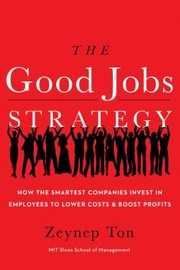
The Good Jobs Strategy
Why Costco, Trader Joe's and QuikTrip pay more and still undercut rivals.
Summary
Ton, an operations professor at MIT, studies low-cost retailers that pay well and argues that the standard trade-off between low prices and good jobs is false when the operating system is designed correctly. Her cases are QuikTrip, Mercadona in Spain, Trader Joe's and Costco, compared against conventional retailers.
Her explanation is operational rather than moral. High employee turnover and understaffing generate costs that do not appear as labour costs: stockouts, misplaced inventory, incorrect pricing, shrinkage, slow checkout, poor customer service and constant retraining. She quantifies these where she can, showing that stores understaffed to save wages lose more in unsold and misshelved inventory than they save. Her four operational choices that make higher pay affordable are: offer less, meaning restrict the assortment so that each item sells enough to justify shelf space; standardise and empower, meaning define the routine work tightly and give employees authority over the exceptions; cross-train, so labour can be moved to where demand is; and operate with slack, meaning staff above the minimum so employees have time to do the improvement work.
The last point is the counterintuitive one and the hardest to sell, since slack looks like waste in every accounting system.
The evidence is case study rather than controlled comparison, and the firms are selected on success, so the causal claim is not established. Critics note that several of her exemplars have unusual characteristics, including private ownership, that make the strategy easier to sustain. The operational diagnosis of hidden costs is the strongest and most transferable part.
Key takeaways 7
- Understaffing to reduce labour cost generates larger losses in stockouts, misplaced inventory, shrinkage and lost sales than it saves in wages.
- Restricting assortment so that each item sells enough to justify its shelf space is what makes higher staffing affordable.
- Standardising routine work tightly while giving employees authority over exceptions produces both consistency and the ability to handle variation.
- Cross-training employees allows labour to move to where demand appears, which converts a fixed cost into a flexible resource.
- Operating with deliberate staffing slack gives employees time to do improvement work, and every accounting system will identify that slack as waste.
- High employee turnover imposes retraining and error costs that do not appear in any labour line and are therefore never managed.
- The trade-off between low prices and good jobs is a consequence of operating design choices rather than an economic necessity.
Who should read it
Operators in retail, hospitality and other high-turnover service businesses who want the operational case for staffing and wage decisions.
Where it sits in the reference 5
Similar books 6
Chosen by shared topics, the entries that hold them, and the people who recommended both.