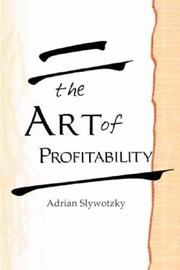
The Art of Profitability
Twenty-three profit models including installed base and switchboard.
Summary
Slywotzky presents twenty-three profit models as a series of conversations between a teacher and a young analyst, one model per weekly session. The models include customer solution profit, pyramid profit, multi-component profit, switchboard profit, time profit, blockbuster profit, profit multiplier, entrepreneurial profit, specialist profit, installed base profit, de facto standard profit, brand profit, specialty product profit, local leadership profit, transaction scale profit, value chain position profit, cycle profit, after-sale profit, new product profit, relative market share profit, experience curve profit, low-cost business design profit, and digital profit.
Each model describes a specific mechanism by which a business converts activity into profit, with a real company as the illustration. The pyramid model, for example, describes using a low-price entry product as a firewall that denies competitors a foothold while the profit comes from the top of the range. The multi-component model describes selling the same product through channels with radically different economics, such as supermarket versus restaurant. The switchboard model describes intermediating many buyers and many sellers so that value accrues to the connector.
The dialogue format makes the book quick to read and it functions as a catalogue for diagnosing where profit sits in a business or an industry. It is prescriptive without being rigorous: there is no data testing which models produce durable returns, the categories overlap, and the examples are from the late 1990s. For founders and investors the useful exercise is to work through the list against a specific company and ask which mechanism actually generates the margin, which is a question many business plans never answer explicitly.
Key takeaways 7
- Profit arises from a specific identifiable mechanism, and a manager who cannot name which of a small number of mechanisms applies to their business does not understand it.
- Market share and profitability are not the same objective, and pursuing share frequently destroys the mechanism that generated profit.
- The pyramid model works by using a deliberately low-margin entry product to deny competitors a base from which to attack the profitable top of the range.
- Selling an identical product through channels with different price sensitivity can generate more profit than any product improvement.
- Installed base profit means the initial sale is priced to build the base and the profit comes entirely from consumables, service or upgrades.
- Profit models have life cycles, so a mechanism that works in one phase of an industry stops working in the next.
- Where a firm sits in the value chain determines its profitability more than how well it executes, and the profitable position moves over time.
Who should read it
Founders and investors who want a catalogue of profit mechanisms to test against a specific business model and identify where margin actually comes from.
Where it sits in the reference 4
Who recommended it 1 · 1 direct
Similar books 6
Chosen by shared topics, the entries that hold them, and the people who recommended both.