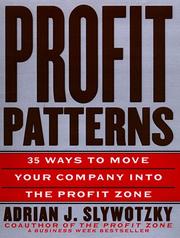
Profit Patterns
How value migrates between business designs in an industry.
Summary
Adrian Slywotzky and colleagues at Mercer Management Consulting wrote this as a catalogue of recurring patterns by which profit moves between firms and between parts of a value chain. It extends the value migration argument of Slywotzky's earlier work.
The book identifies roughly thirty patterns grouped into categories: megapatterns such as the shift from vertical integration to de-integration, value chain patterns such as the movement of profit to the point where the customer's decision is made, customer patterns such as the fragmentation of a mass market into microsegments, channel patterns such as channel compression and multiplication, product patterns such as the transition from product to brand to solution, knowledge patterns, organisational patterns and capital patterns. Each is illustrated with company cases from the 1980s and 1990s.
The method is pattern recognition rather than analysis: Slywotzky's claim is that these configurations recur across industries and that a manager who knows them can identify where profit will move next in their own. The weakness is that the patterns are identified retrospectively and no test is offered of whether they predict. Many of the cases have aged badly, and the book's confidence about which companies had positioned themselves correctly reads awkwardly now. The underlying observation, that industry profitability moves between stages of a value chain and that market share and profitability decouple, is sound and remains useful.
Key takeaways 7
- Profit migrates between stages of a value chain, so a firm can gain share in a stage that is losing all of its profitability.
- Market share and profit share decouple, and managing for the first can destroy the second.
- Profit concentrates at the point in a chain where the customer's purchase decision is actually made.
- Vertical integration and de-integration alternate as the constraint in an industry shifts between coordination and specialisation.
- Business model design determines profitability more reliably than operational execution within a given model does.
- Slywotzky argues that patterns repeat across unrelated industries, so managers can anticipate their own industry by studying others.
- Value chains reconfigure faster than firms can reposition, which is why incumbents lose profit while retaining volume.
Who should read it
Executives and investors looking for a vocabulary for how industry profitability shifts between players and stages, treating the pattern catalogue as suggestive rather than predictive.
Where it sits in the reference 2
Similar books 6
Chosen by shared topics, the entries that hold them, and the people who recommended both.