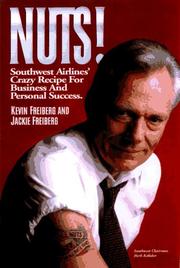
Nuts! Southwest Airlines' Crazy Recipe for Business and Personal Success
The best-known account of the Kelleher-era culture.
Summary
The Freibergs wrote an admiring account of Southwest Airlines and of Herb Kelleher's leadership, covering the founding and the legal fight to be allowed to fly, the operating model, the culture and the employee practices.
The operating substance is real even when the framing is promotional. Southwest flew a single aircraft type, the Boeing 737, which cut training, maintenance, parts inventory and scheduling complexity simultaneously. It flew point to point rather than through hubs, which avoided the connection banking that leaves aircraft on the ground. It achieved turnaround times of around fifteen minutes when competitors took an hour, which meant more flights per aircraft per day from the same capital. It did not offer assigned seats, meals, interline baggage transfer or connections to other carriers, each of which removed cost and complexity. It flew into secondary airports with lower fees and less congestion. The cost structure that resulted was one no legacy carrier could match without dismantling its own network.
The cultural material covers hiring for attitude, the humour, the unusually good labour relations despite heavy unionisation, and profit sharing.
The book is essentially a celebration and has no critical distance. It is from 1996, before the industry consolidation, before Southwest's cost advantage narrowed as it aged and its workforce gained seniority, and before the model was copied worldwide by Ryanair, easyJet and others. The operating decisions and their interlocking logic are what to take from it.
Key takeaways 7
- Flying a single aircraft type cut training, maintenance, parts inventory and scheduling complexity at once, and the savings compounded across every function.
- Fifteen-minute turnarounds generated more flights per aircraft per day, which produced more revenue from the same capital than any pricing decision could.
- Point-to-point routing avoided the connection banking that leaves aircraft idle at hubs waiting for feeder flights.
- Removing assigned seats, meals, interline baggage and connections each eliminated cost and complexity that customers did not value at the price.
- Secondary airports offered lower fees and less congestion, which supported both the cost structure and the turnaround times.
- The operating decisions interlocked, so a competitor could not copy any one of them without adopting the others.
- Legacy carriers could not match the cost structure without dismantling their own network economics, which is why the advantage persisted for decades.
Who should read it
Operators studying how interlocking operating decisions produce a cost position competitors cannot copy, read past the promotional framing.
Where it sits in the reference 4
Similar books 6
Chosen by shared topics, the entries that hold them, and the people who recommended both.