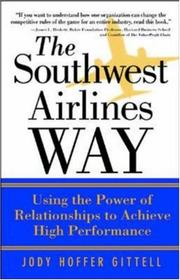
The Southwest Airlines Way
Academic study of relational coordination and turnaround times.
Summary
Gittell, an organisational researcher, studied why Southwest Airlines turned aircraft around faster and with fewer errors than its competitors. Her field research covered Southwest, American, United and Continental, with observation at multiple stations and interviews across twelve job functions involved in turning an aircraft.
Her explanatory concept is relational coordination, which she defines as coordination carried out through relationships of shared goals, shared knowledge and mutual respect, supported by frequent, timely, accurate and problem-solving communication. She measured it by surveying members of each function about their communication with every other function, then correlated the resulting scores with operational outcomes including turnaround time, on-time performance, baggage handling errors and customer complaints. Southwest scored highest on relational coordination and best on the outcomes, and the relationship held across stations within each airline.
The organisational practices she identifies as producing it are specific. Southwest hired for teamwork rather than technical skill. It used supervisors as coaches with small spans of control rather than as monitors. It investigated delays through a process designed to find the coordination failure rather than the person to blame. It kept job boundaries flexible so that people crossed functional lines to help. It measured team outcomes rather than individual departmental metrics, and it negotiated union contracts that permitted this flexibility.
The research is genuine and the measurement approach was influential in operations and healthcare research afterward. The limitation is that Southwest has changed substantially since 2003, growing far larger, adding assigned seating and larger aircraft, and its operational advantage has narrowed. Whether the practices survive scale is exactly the question the book cannot answer.
Key takeaways 7
- Coordination quality across functions, not individual worker productivity, explains most of the difference in airline turnaround performance.
- Relational coordination can be measured by surveying each function about its communication with every other function.
- Assigning blame for delays destroys the information flow that would prevent the next delay.
- Small supervisory spans of control allow supervisors to coach rather than monitor, which is what produces coordination.
- Flexible job boundaries let workers cross functional lines during disruptions, which is when coordination matters most.
- Departmental performance metrics create the functional silos that damage overall operational outcomes.
- Southwest's union relationships enabled rather than obstructed flexibility, contradicting the standard assumption about unionised airlines.
Who should read it
Operators running processes that require many specialised functions to coordinate under time pressure, particularly in operations, logistics and healthcare.
Where it sits in the reference 2
Who recommended it 1
Similar books 6
Chosen by shared topics, the entries that hold them, and the people who recommended both.